
How to Write Chinese Numbers 1-10: Stroke Order for Every Character
The characters for one through ten — 一 二 三 四 五 六 七 八 九 十 — are the classic first lesson in Chinese writing, and they are the building blocks you will meet inside names, dates, and prices. This guide walks through each number with its exact stroke order, stroke names, and a memory hook, illustrated frame by frame from a beginner writing lesson so you can copy what you see.
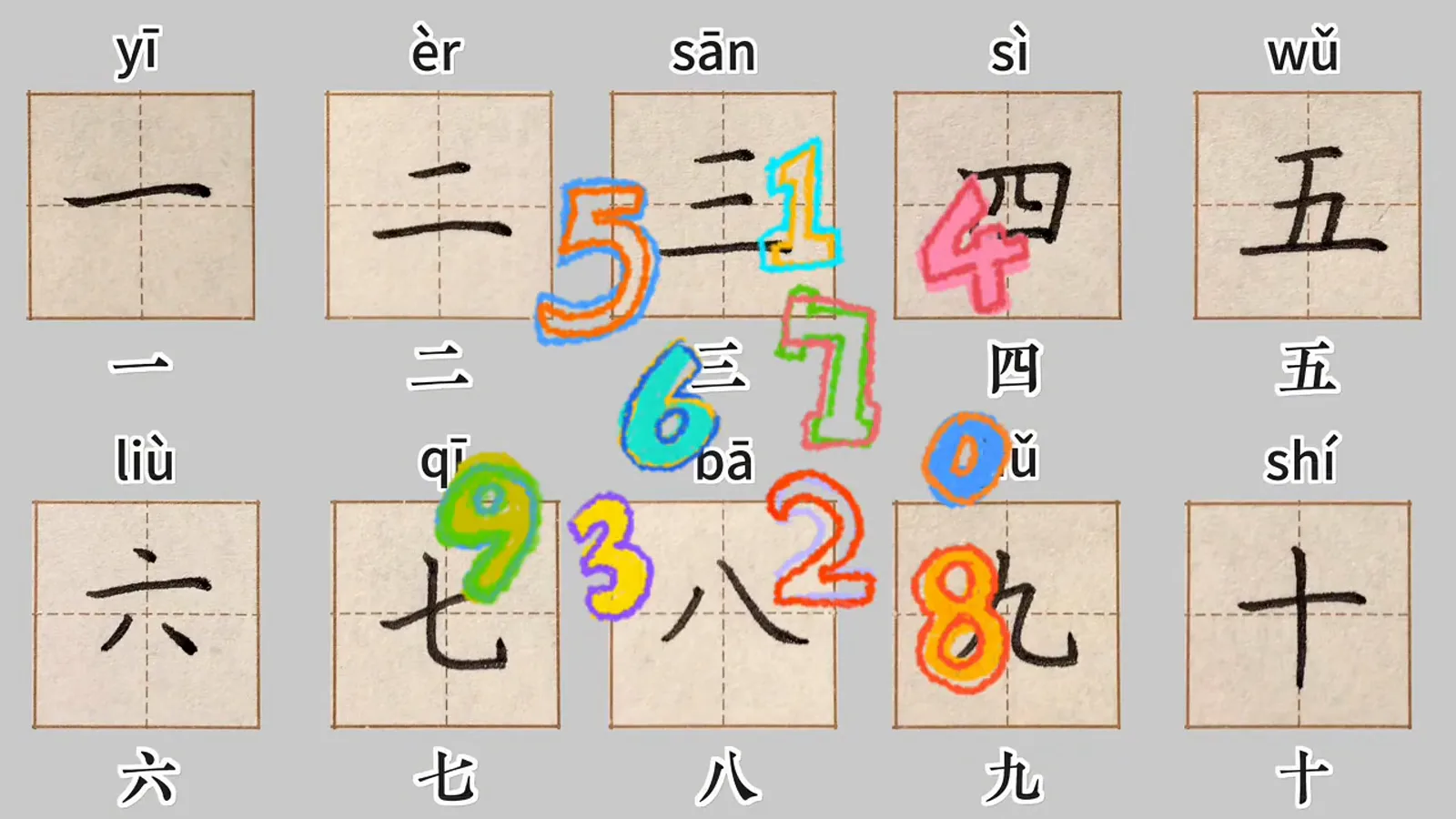
Key takeaways
- Numbers 1-3 are pure horizontal strokes: 一 has one, 二 has two, 三 has three — each new stroke adds a line.
- Always write horizontals top to bottom and left to right; in 二 and 三 the bottom stroke is the longest.
- 四 encloses a small bent stroke inside a flattened 口; 五 ends with its longest horizontal.
- 六 and 八 pair a downward-left piě with a right-side stroke — short piě, long nà in 八.
- 七 and 九 both hide a hooked bend: the turn stays rounded and the hook springs straight up.
- 十 crosses a long horizontal with a hanging-needle vertical — and no number needs more than five strokes.
One to ten, one character at a time
- 1
一 yī — one horizontal stroke
The simplest character in the language: a single horizontal stroke called héng. When you write it, tilt the line very slightly upward as you move left to right, and finish a touch heavier than you started. One stroke, one sound: yī.
一 is a single slightly upward-tilted héng stroke.Watch at 0:20 - 2
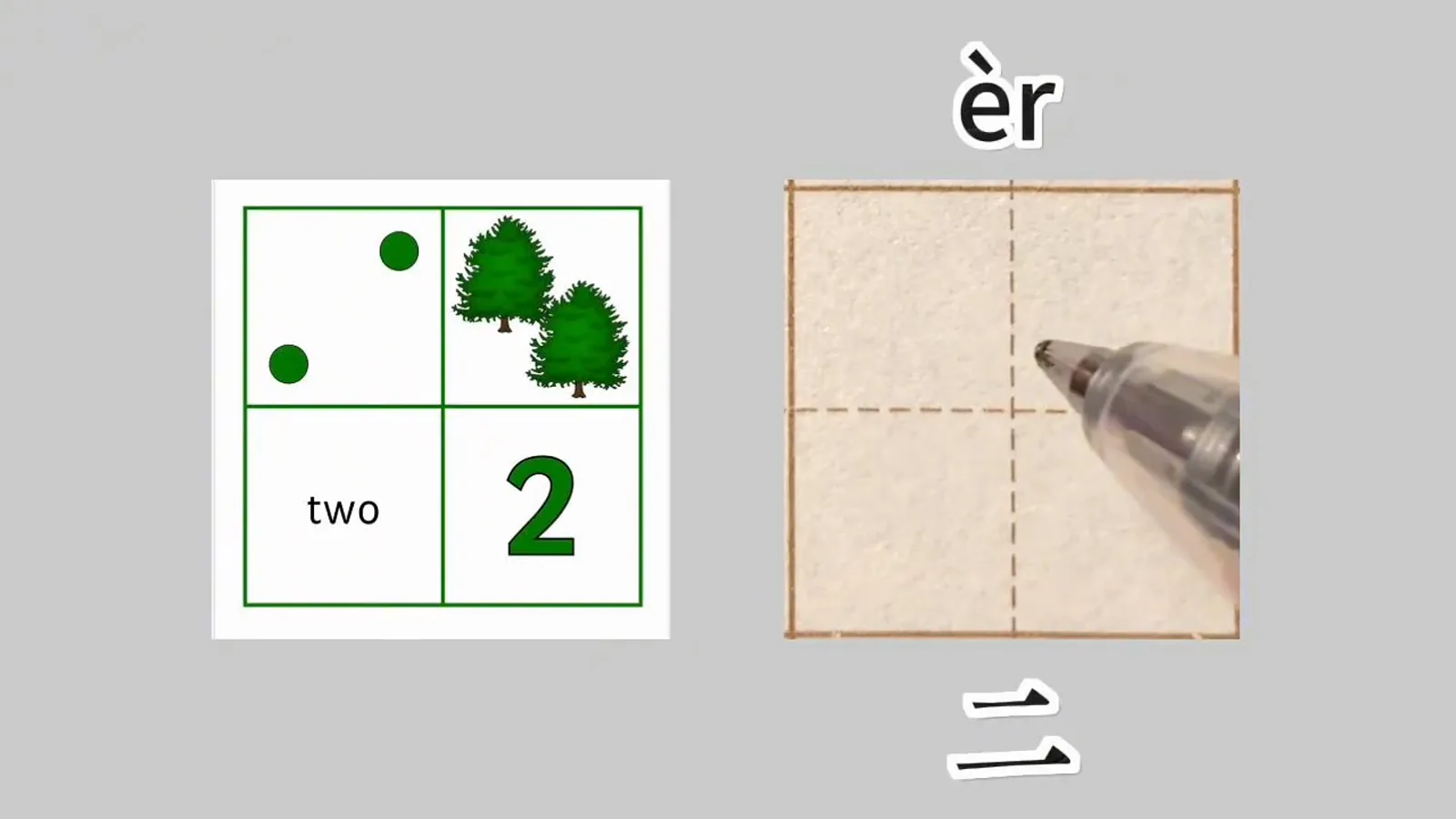
二 èr — two horizontals, short over long
Two héng strokes stacked with a clear rule: the upper stroke is shorter, the lower stroke longer. Write the top one first, then the bottom. That short-over-long proportions rule is your first taste of how Chinese characters balance themselves.
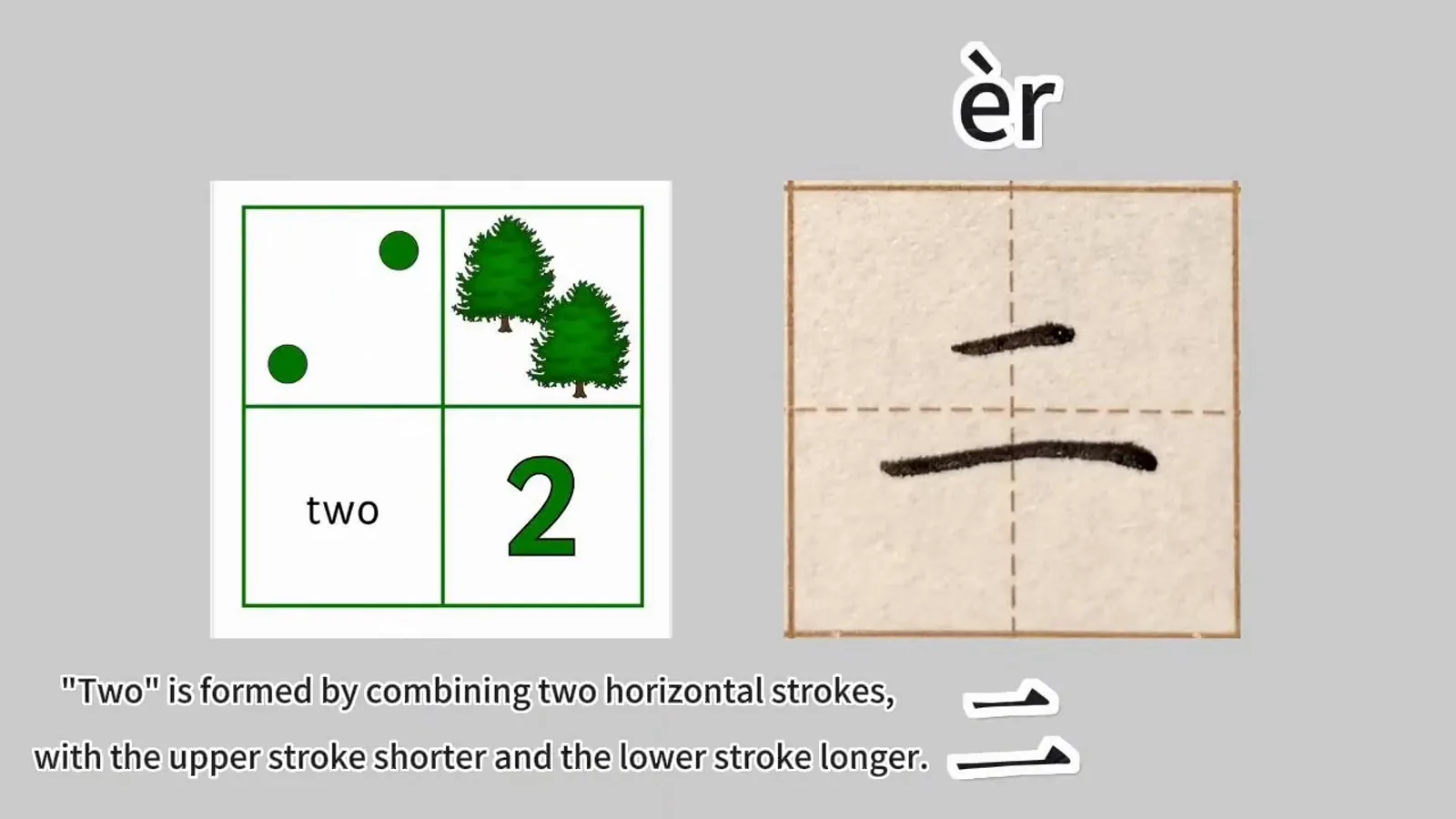
二 stacks two horizontals — upper short, lower long.Watch at 0:50 - 3
三 sān — three horizontals with the longest at the bottom
Add a third horizontal and you get sān. The two upper strokes stay short and close together; the bottom stroke is the longest and carries the character. Same top-to-bottom order as 二 — you are just adding a middle line.
三 keeps the upper strokes short and the bottom longest.Watch at 1:00 - 4
四 sì — a flattened box with a hidden inside
四 stops being obvious: it is a flattened 口 frame — left vertical, top bend, right vertical, bottom seal — with a small piě and a bent vertical tucked inside. Write the outside frame first, the inside strokes before sealing the bottom. Five strokes total, and it looks a little like a curtained window.
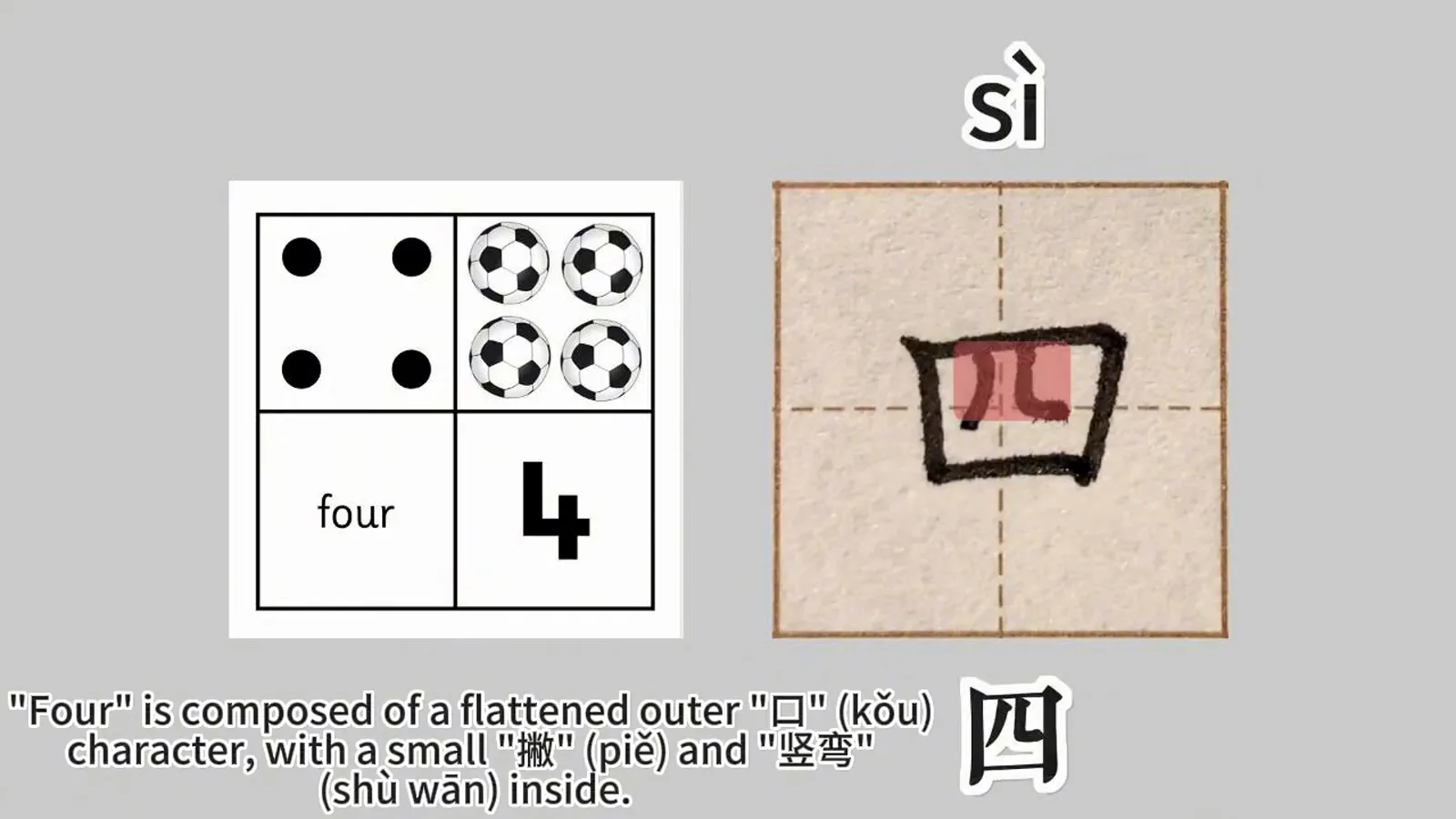
四 wraps a small piě and bent vertical inside a flat box.Watch at 1:40 - 5
五 wǔ — save the main horizontal for last
五 has four strokes: top horizontal, the vertical-and-bend, the middle stroke, then the long bottom horizontal. That bottom line is the main stroke — emphasize it and let it run wider than everything above. It anchors the character the way the bottom line of 三 does.
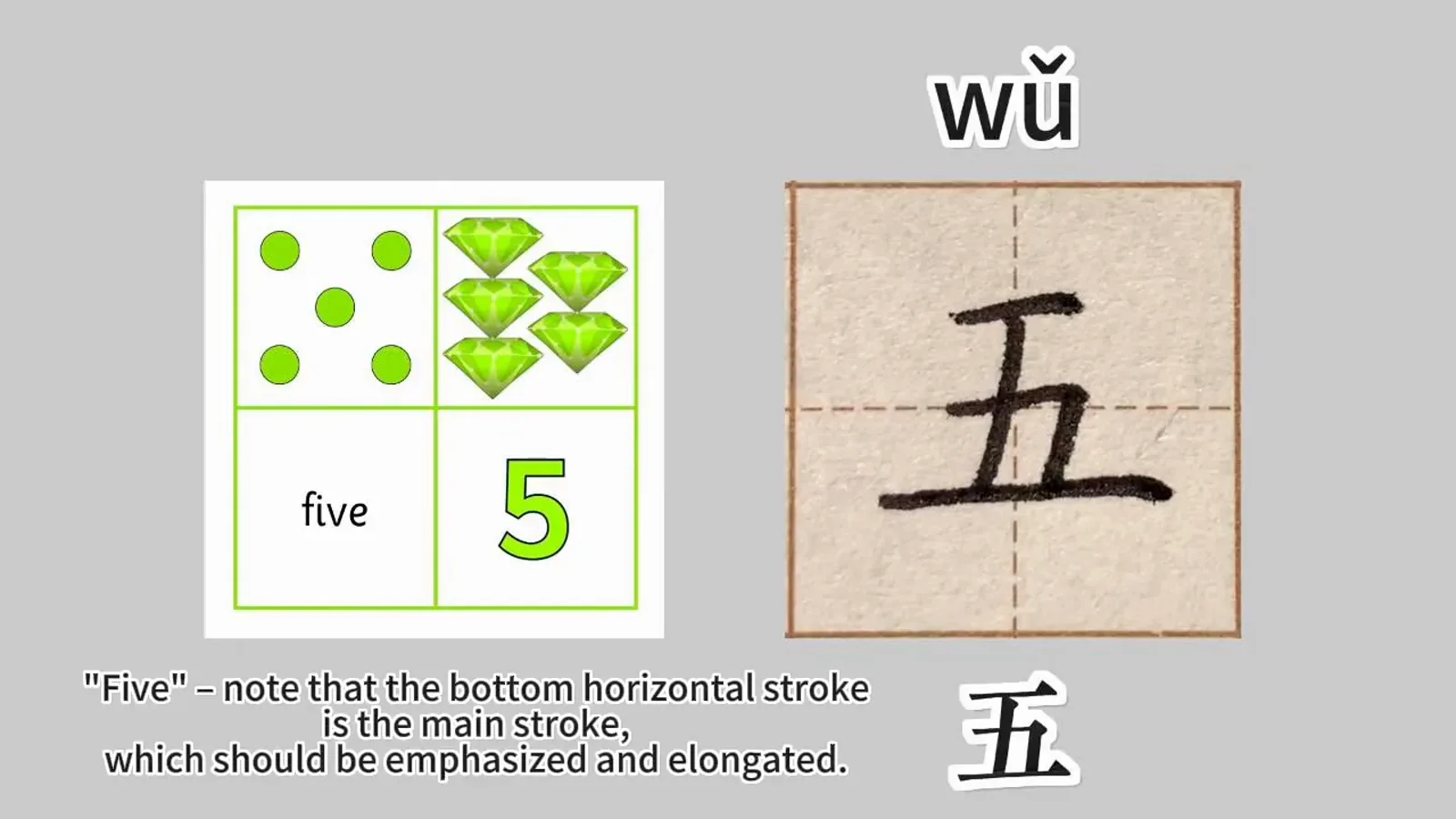
五 ends with an emphasized, elongated bottom horizontal.Watch at 2:00 - 6
六 liù — a piě and a dot with opposite pressure
六 pairs its last two strokes with opposite rules: the downward-left stroke (piě) goes from heavy to light, while the dot on the right goes from light to heavy. Four strokes — dot, horizontal, piě, dot — and you have written a number that hides inside many names.
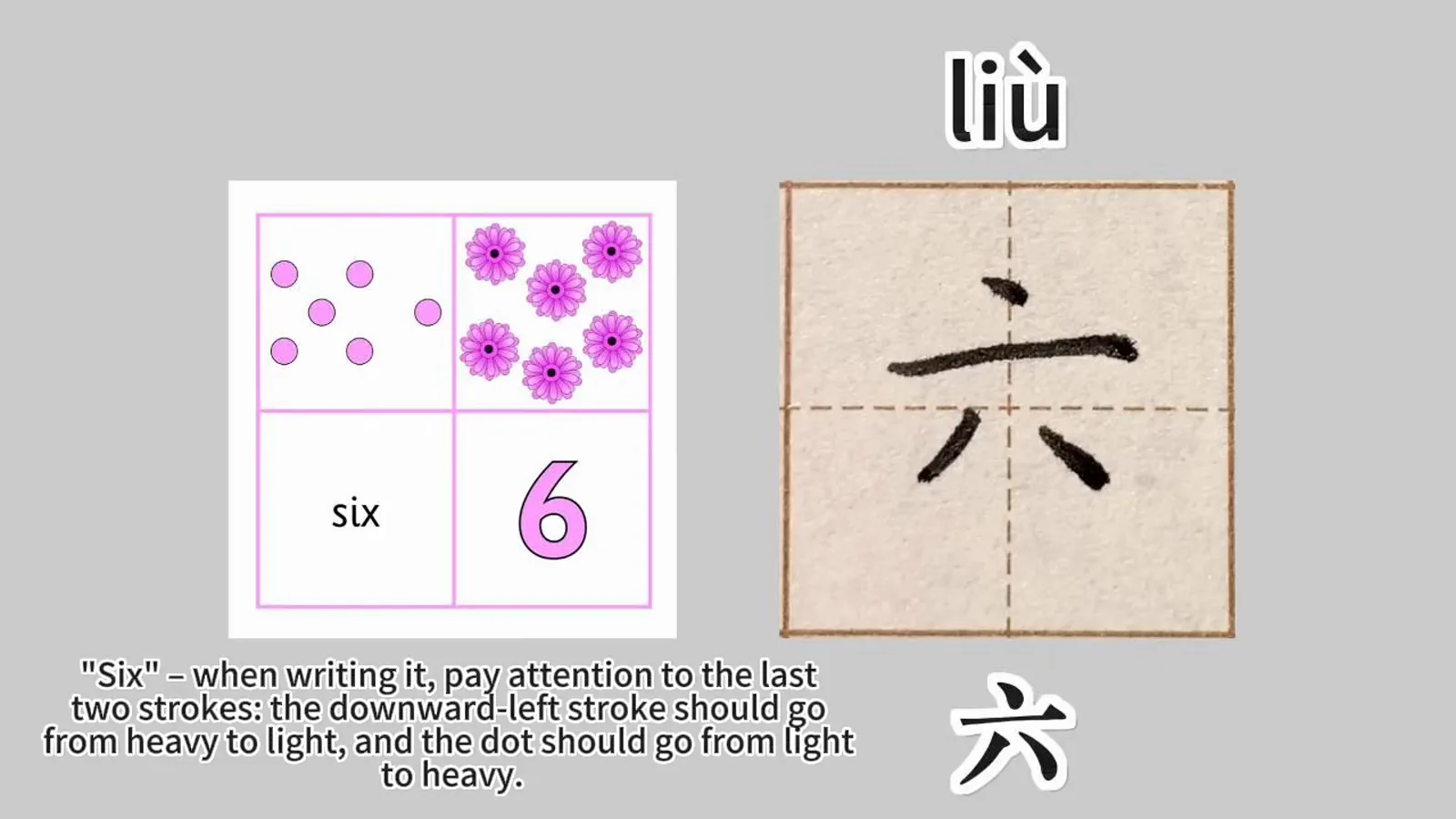
六 contrasts a heavy-to-light piě with a light-to-heavy dot.Watch at 2:20 - 7
七 qī — a horizontal with a hooked tail
七 has just two strokes: a slightly rising horizontal, then the signature stroke — a vertical that bends to the right and hooks upward. Keep the turn rounded, not angular, and let the hook spring out swiftly and directly up. That bend-hook is the shù wān gōu, one of the most reused strokes in Chinese.
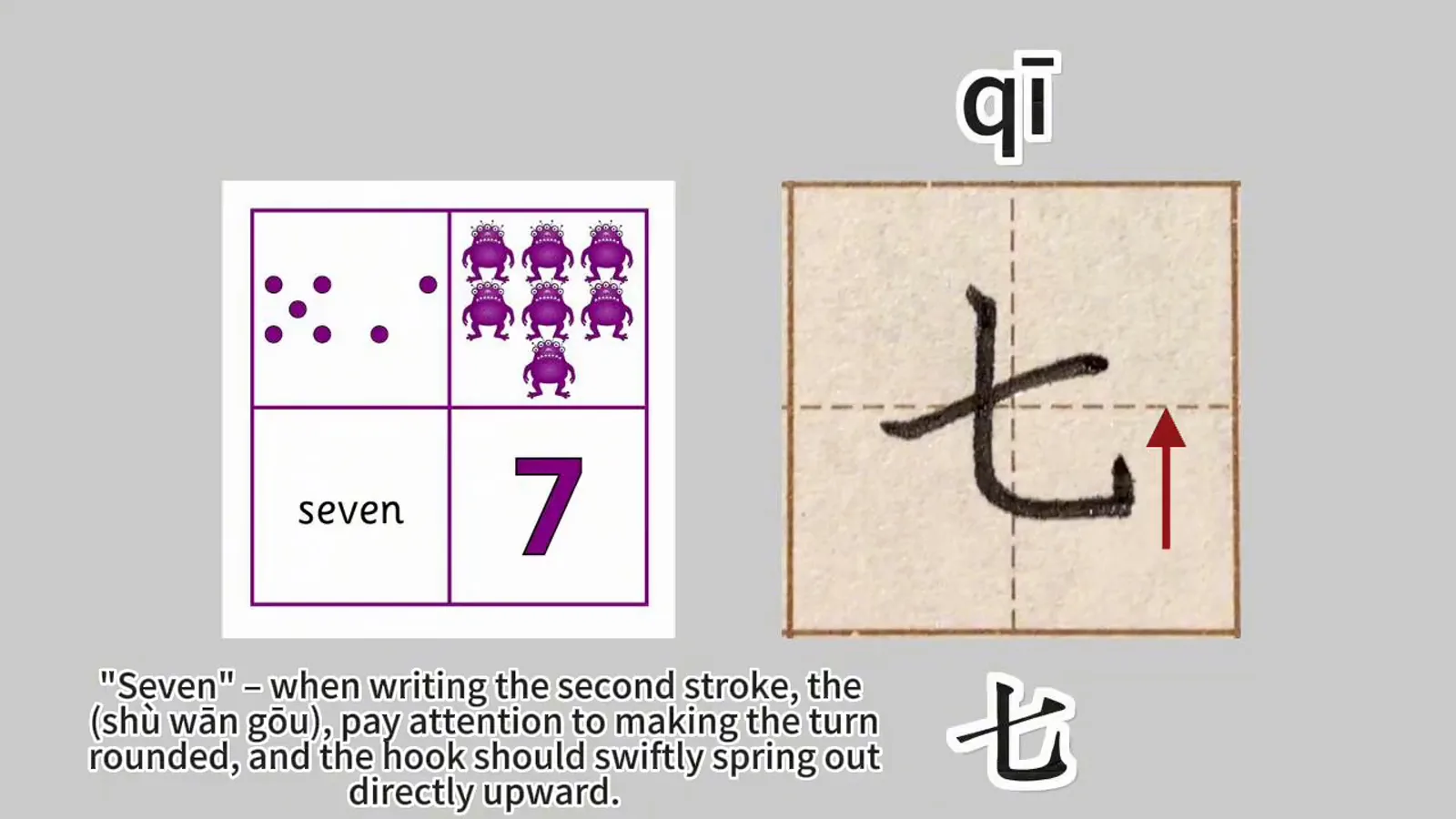
七's second stroke bends right and hooks straight up.Watch at 3:00 - 8
八 bā — short piě, long nà
Two strokes that splay outward like open legs: a downward-left piě kept short, and a downward-right nà stretched long. The contrast is the character — if the two sides match in length, 八 loses its shape. Think of it as chopsticks, which is a classic memory hook since dinner at eight o'clock is bā diǎn.
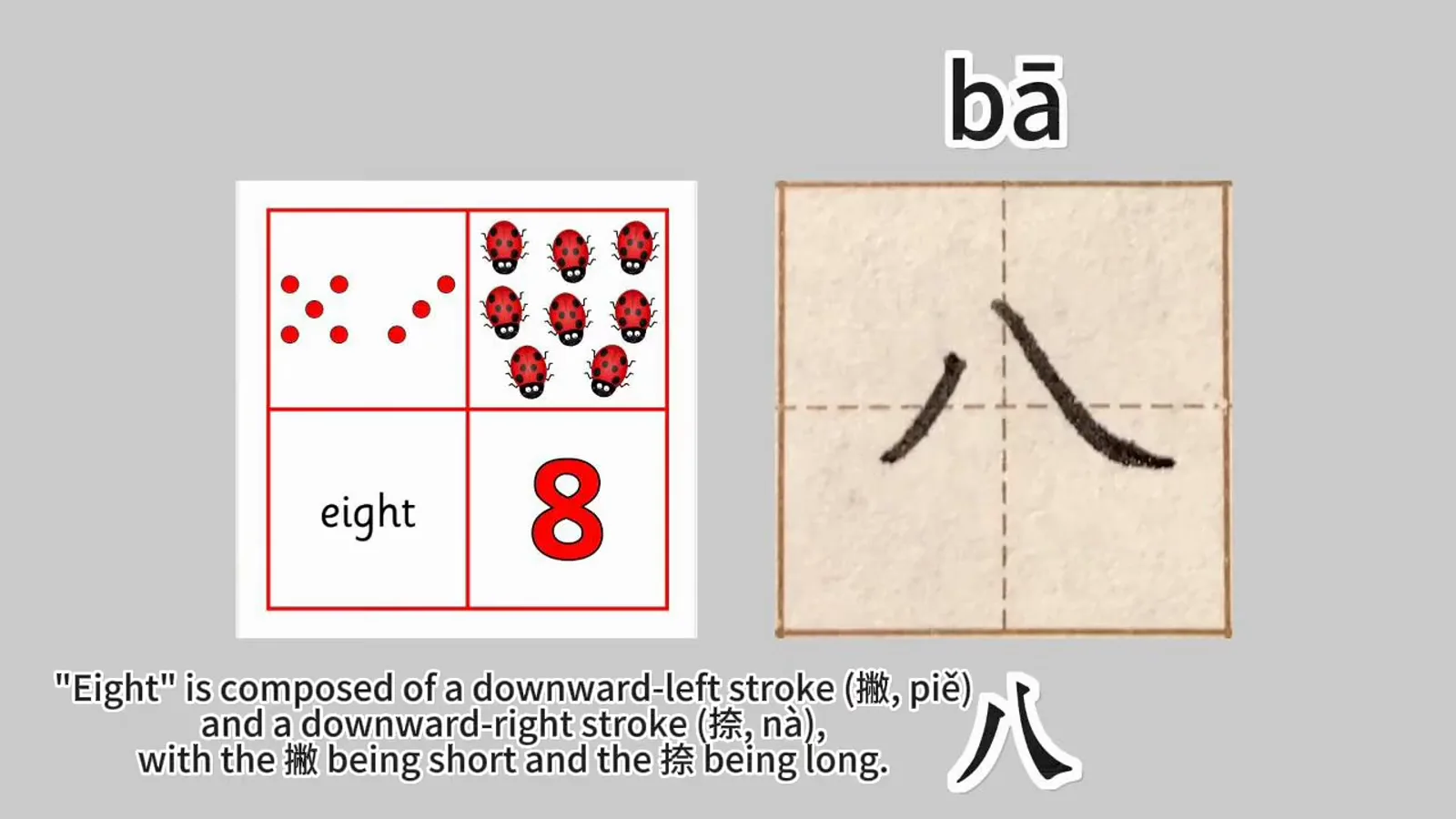
八 splays a short piě against a long nà.Watch at 3:25 - 9
九 jiǔ — the horizontal bend hook
九 is also two strokes: a horizontal with a slight left-falling start, then the héng zhé wān gōu — horizontal, rounded turn downward, curve to the left, and a hook that springs directly upward. It is trickier than 七's hook because of the extra bend, so slow down at the turn and keep it rounded.
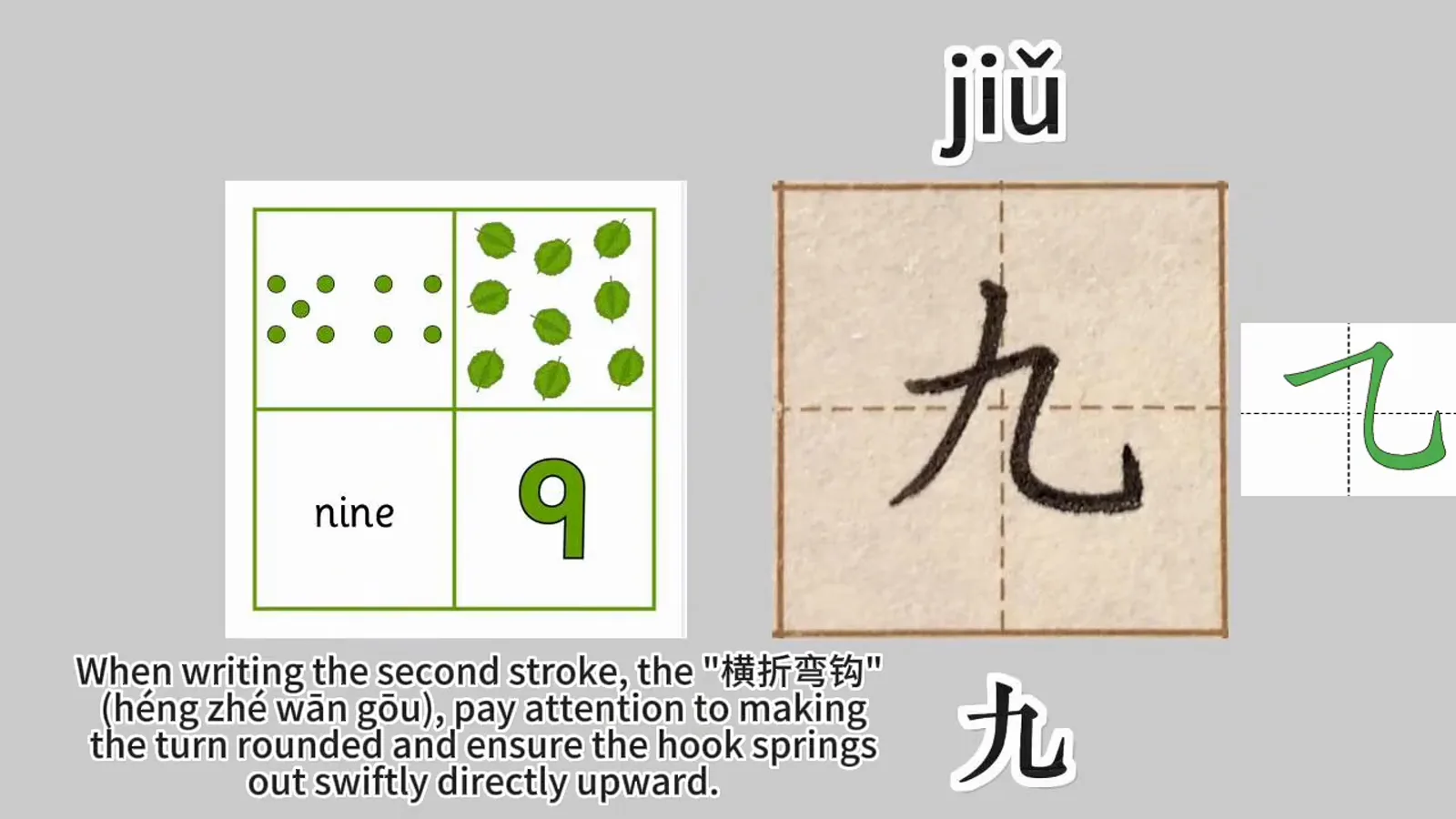
九 ends in the rounded héng zhé wān gōu hook.Watch at 3:40 - 10
十 shí — a cross with a needle point
The last number is a cross: first a long horizontal, then a vertical that starts slightly heavy and tapers to a point — the hanging-needle vertical (xuán zhēn shù). Only two strokes, and it closes the set. Rotate it a little and it even resembles the Roman numeral X, which makes it impossible to forget.
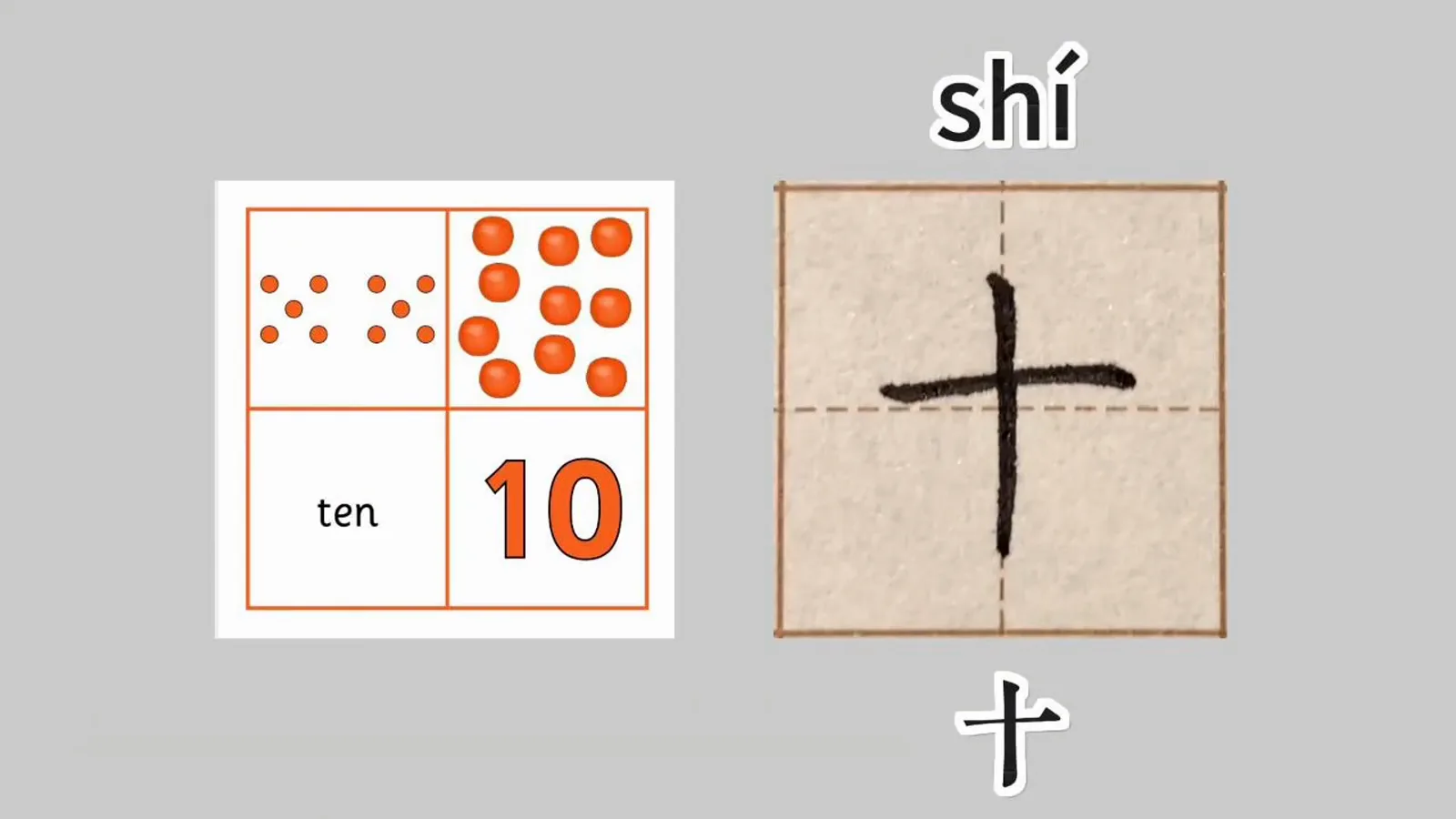
十 crosses a long horizontal with a tapering vertical.Watch at 4:05
Frequently asked questions
- How many strokes does each Chinese number have?
- 一 has 1, 二 2, 三 3, 四 5, 五 4, 六 4, 七 2, 八 2, 九 2, and 十 2. Notably, the visual simplicity does not match the count: 四 with five strokes is the busiest of the set.
- Do stroke directions really matter for numbers?
- Yes. Six and eight depend on pressure direction — piě runs heavy-to-light while dots run light-to-heavy — and 七 and 九 only read as clean characters when the hook springs upward. Writing them in the wrong direction is the most common beginner giveaway.
- How do I remember the difference between 七 and 九?
- Both end in an upward hook, but 七 starts its second stroke from the top and bends once, while 九 begins with a horizontal and bends twice. Think: seven bends once, nine bends twice.
- Where do number characters show up in Chinese names?
- Characters like 十, 六 and 八 appear as components inside many name characters, and numbers themselves carry lucky meanings — 八 for prosperity, 九 for longevity. If you generate a Chinese name, spotting these ten characters inside it is a great first reading exercise.
Keep going
© 2026 AIChineseName.