
Wu Xing Explained: Wood, Fire, Earth, Metal and Water in One Video
Every Chinese name is a small five-element system: each character leans toward wood, fire, earth, metal or water, and the mix shapes the name's character. This walkthrough follows a three-minute whiteboard explainer frame by frame — from the theory's 700 B.C. origins and its surprising Greek parallel, through the correspondence table of seasons, organs, emotions and colours, to the generating and controlling cycles that keep the elements in balance. By the end you will be able to read what your own name's elements mean.
Key takeaways
- Wu xing is best translated as 'five phases' rather than 'five elements' — the five are processes with their own movement, season and taste, not five kinds of matter.
- The theory grew out of the same school as yin-yang, with first references around 700 B.C., and was independently described by Hippocrates in Greek medicine.
- Each element carries its own season, climate, organ, emotion, colour and taste, recorded in an ancient book called the Simple Question and still used by TCM practitioners.
- In the generating cycle every element feeds another: wood to fire to earth to metal to water and back to wood.
- The controlling cycle keeps balance — fire controls metal, metal generates water, and water in turn controls fire.
- Imbalance travels: prolonged anger strains wood and the liver, while excess sugar overloads earth — the over-controlling and insulting sequences explain how one element's excess spills into another.
The five elements explained, frame by frame
- 1
Meet wu xing, the five phases
Wu xing is a theory from Chinese medicine, best translated as 'five elements' or 'five phases'. It was developed by the same school of thought that produced the yin-yang theory, and the first references to it date back to about 700 B.C. — the board opens by planting that date right under the yin-yang symbol.
The opening board: wu xing, five elements or five phases, dated to 700 B.C.Watch at 0:15 - 2
The same idea appeared in Greek medicine
The explainer adds a surprising footnote: the five-element theory was also described in Western medicine, by the Greek doctor Hippocrates. This way of thinking was, one can say, the start of observing natural causes for disease instead of blaming everything on supernatural powers — elemental medicine was a shared early attempt to systematise health, not a Chinese curiosity.
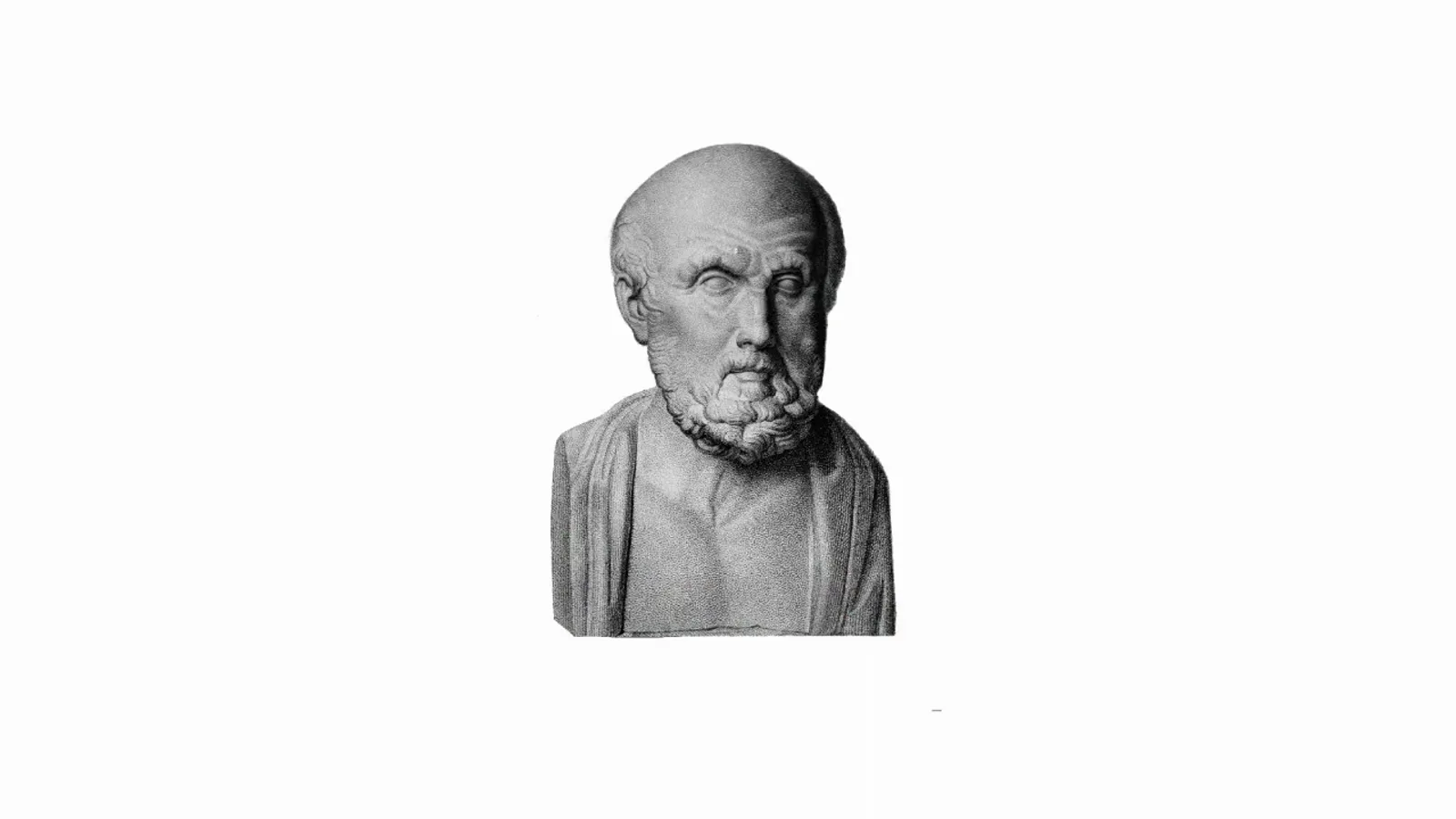
Hippocrates, whose Greek medicine described a five-element theory of its own.Watch at 0:21 - 3
Five processes, not five materials
The five are fire, earth, water, metal and wood — but they are not five sorts of fundamental matter. They are five processes, each with its own movement, season and taste. These qualities were observed over time by multiple philosophers and gathered in an ancient book called the Simple Question, shown here beside a portrait of a classical physician.
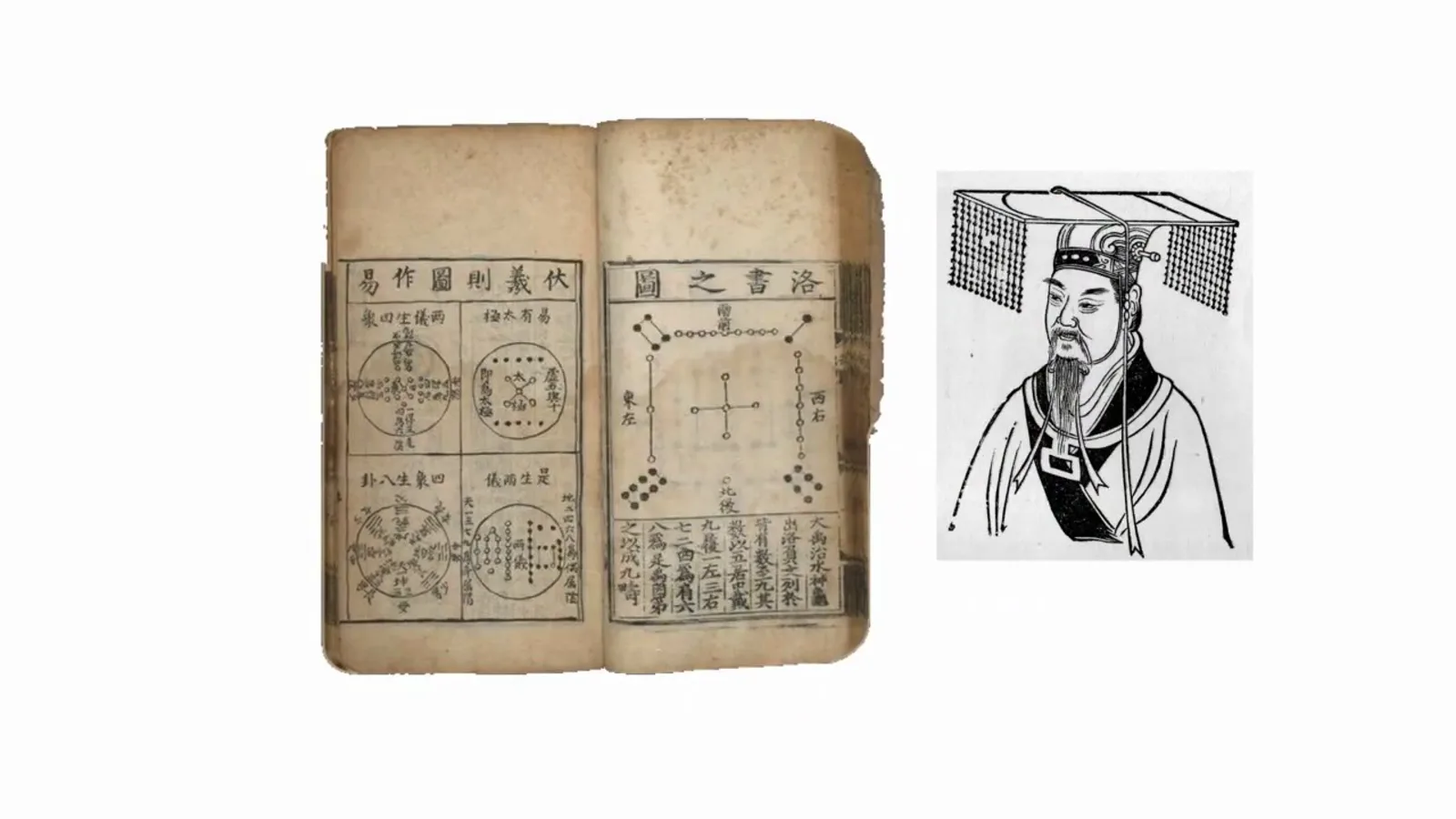
The Simple Question, the ancient book that collected the elements' observed qualities.Watch at 0:53 - 4
Read the great correspondence table
This table shows some of the correspondences found in the Simple Question, still used by TCM students and practitioners all over the world. Each column is one element — wood, fire, earth, metal, water — and each row is one quality: orientation, season, climate, cultivation, the yin and yang organs, tissues, emotions, colour, taste and voice. Wood belongs to spring and the liver, fire to summer and the heart, earth to late summer and the stomach, metal to autumn and the lungs, water to winter and the kidneys.
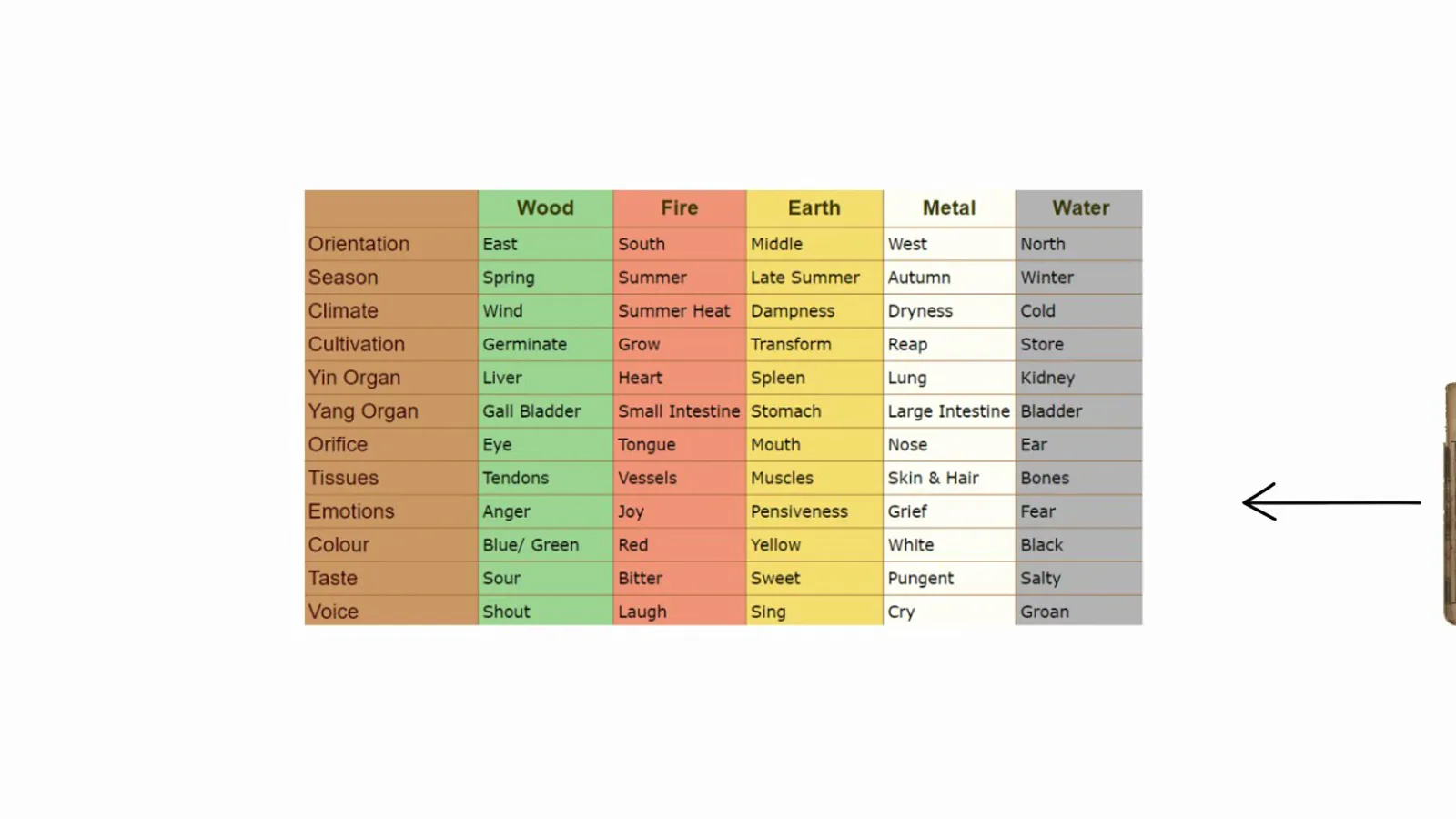
Five columns, one per element — season, climate, organ, emotion, colour and more.Watch at 0:59 - 5
Follow the generating cycle around the ring
Besides their own qualities and phenomena, the five elements are interrelated through cycles. The generating cycle states that every element generates another one — drawn here as a ring of arrows in which each element hands its energy to the next: wood to fire, fire to earth, earth to metal, metal to water, and water back to wood. The circle has no beginning and no end.
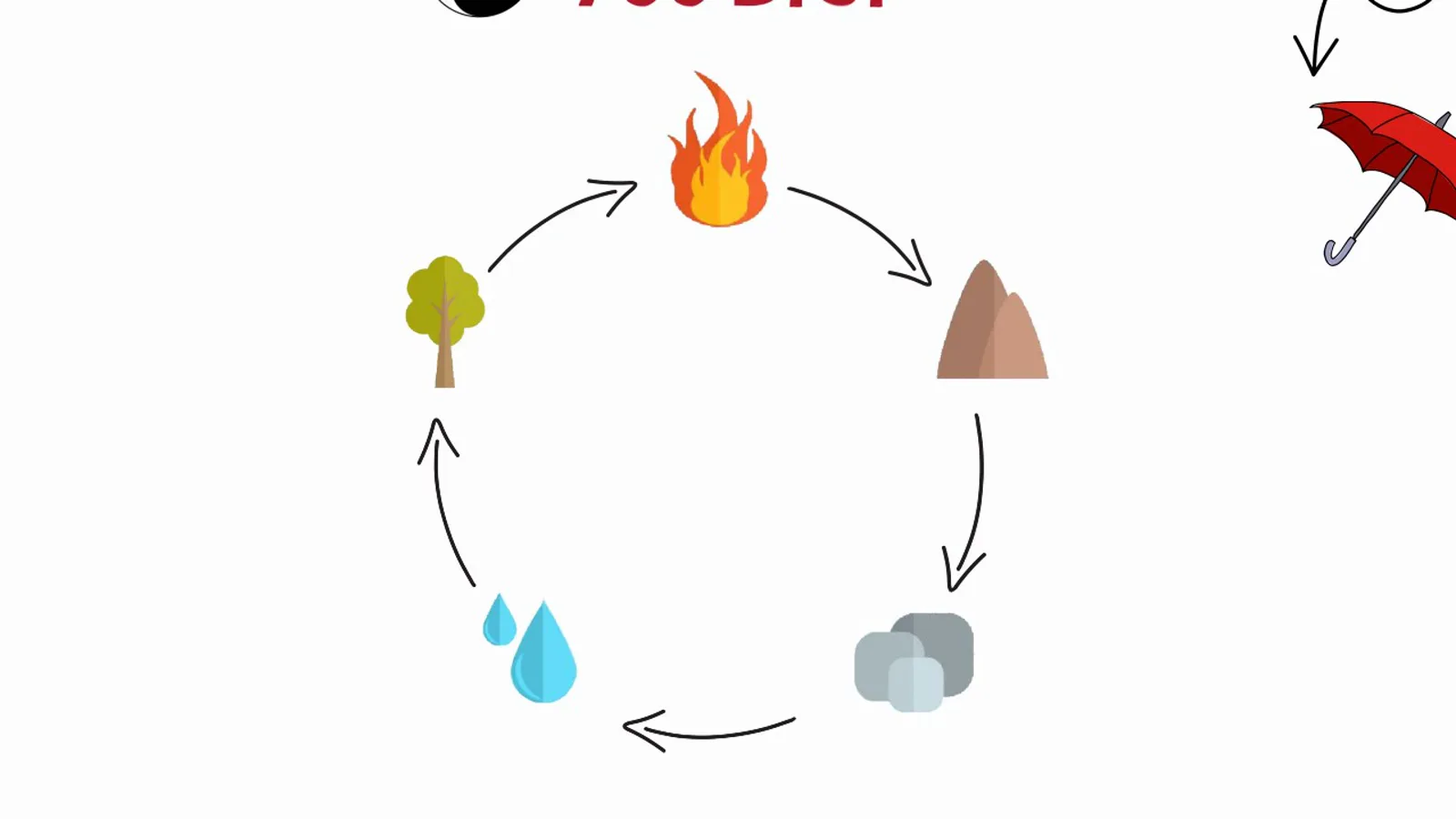
The generating cycle: each element feeds the next around the ring.Watch at 1:15 - 6
Add the controlling cycle, the five-pointed star
Overlaid on the ring is a second set of arrows — the controlling cycle, drawn as a five-pointed star. It should maintain a certain balance between the five elements: while each element generates the next, it also keeps another element in check. Health, in this model, is the two cycles running smoothly together.
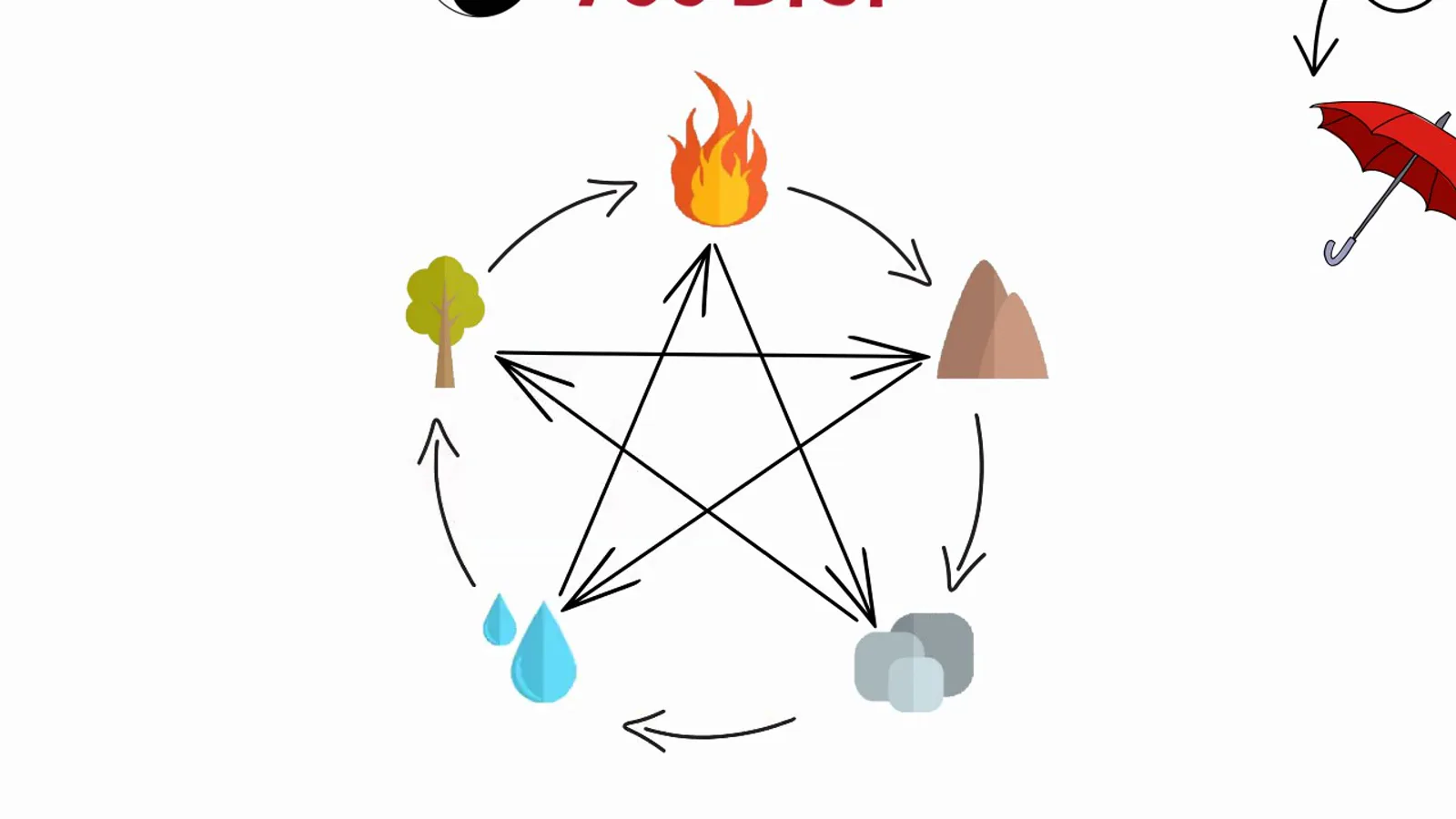
The controlling cycle drawn as a star across the generating ring.Watch at 1:21 - 7
One example: how fire, metal and water check each other
The video uses fire to demonstrate how the star works. Fire controls metal; at the same time, metal generates water, and water in its turn controls fire. Every element is both restrained and supported, and this pattern is found in every element of the system — nobody sits at the top.
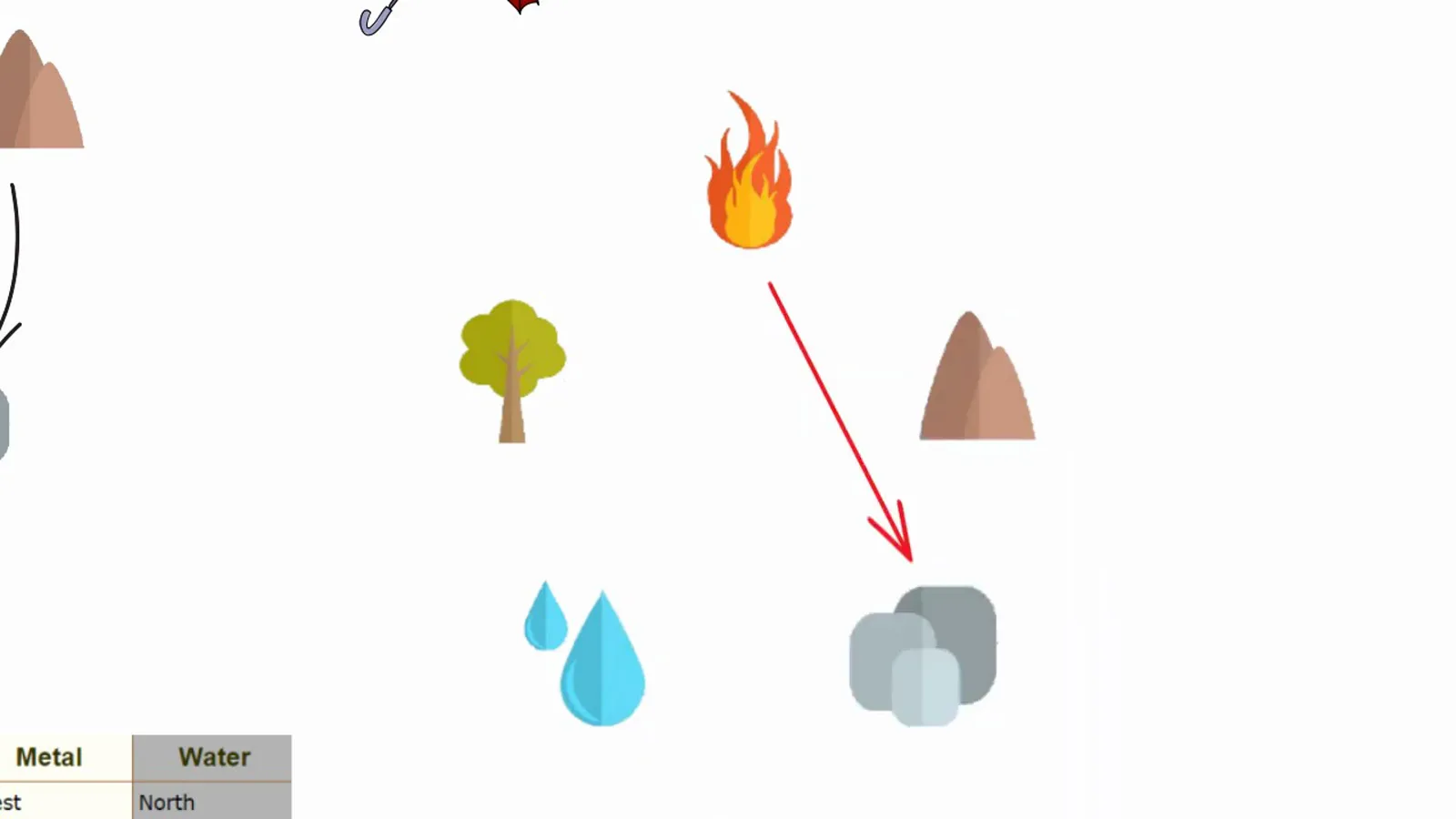
Fire controls metal, metal generates water, water controls fire.Watch at 1:27 - 8
Trace an imbalance: long anger strains wood and the liver
Unfortunately our lives are full of factors that can put our elements out of balance. When someone is angry for a long period of time, the table tells us this can eventually disbalance the wood element. Since wood is related to the liver, the liver's energy can become stagnant or turn into heat — with symptoms including a short temper, headaches, burning eyes or insomnia.
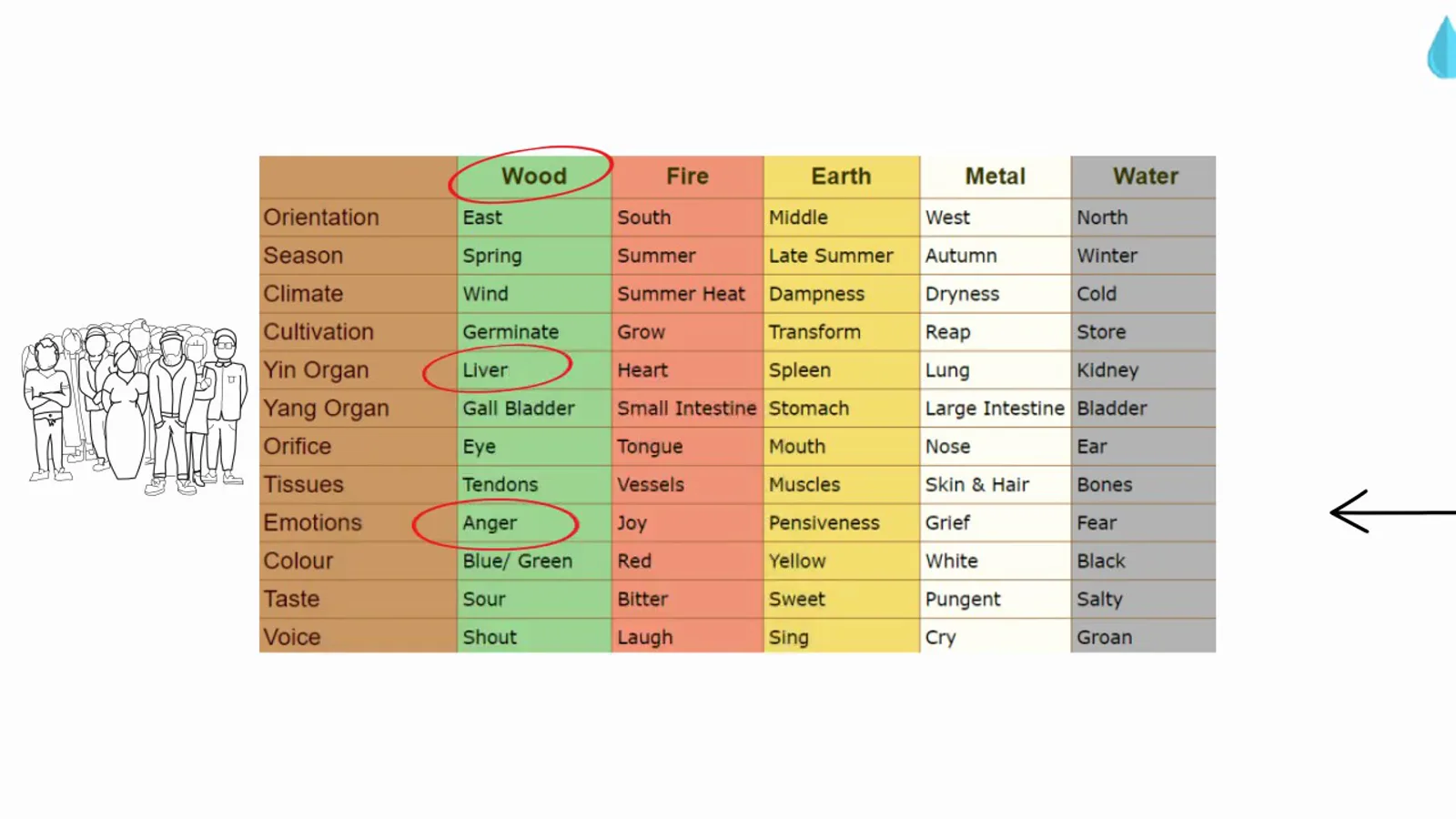
Wood, liver and anger circled on the table — the chain behind chronic irritability.Watch at 2:00 - 9
The over-controlling sequence: wood harasses earth
Relatively speaking, an excess wood element can harm the earth element — the video calls this the over-controlling sequence. If the situation continues, the earth element becomes repressed, and earth-related symptoms like nausea, weak digestion and tiredness can arise. One element's surplus is never contained; it spills onto the element it controls.
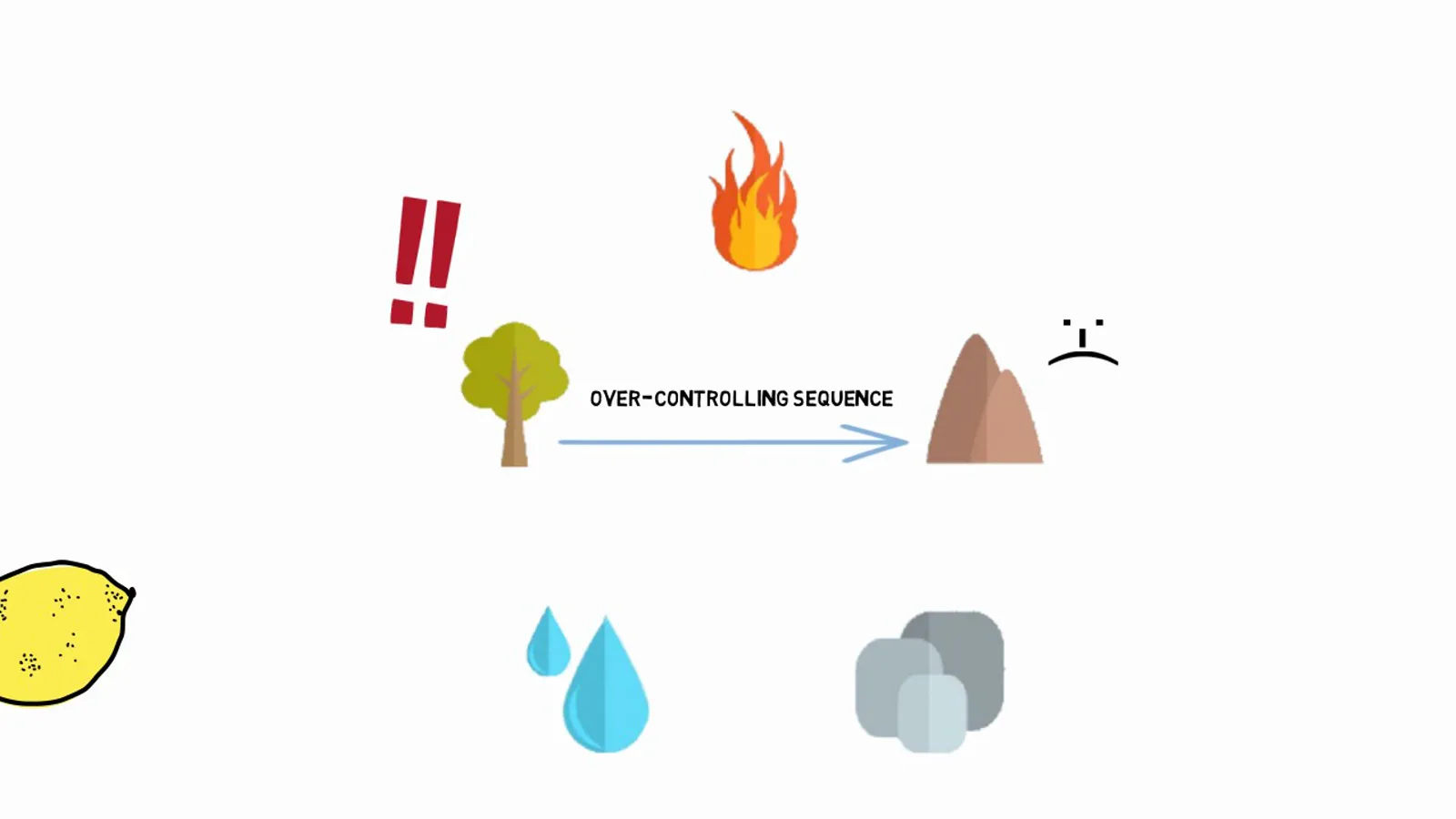
Excess wood over-controls earth, and digestive symptoms follow.Watch at 2:19 - 10
The insulting sequence: too much sugar bogs down wood
It can also be the other way around. If you crave sugar and eat too much fast food, this can cause an excess in your earth element, in the form of dampness. That dampness then impairs the wood element in its function — a reversal the video calls the insulting sequence.
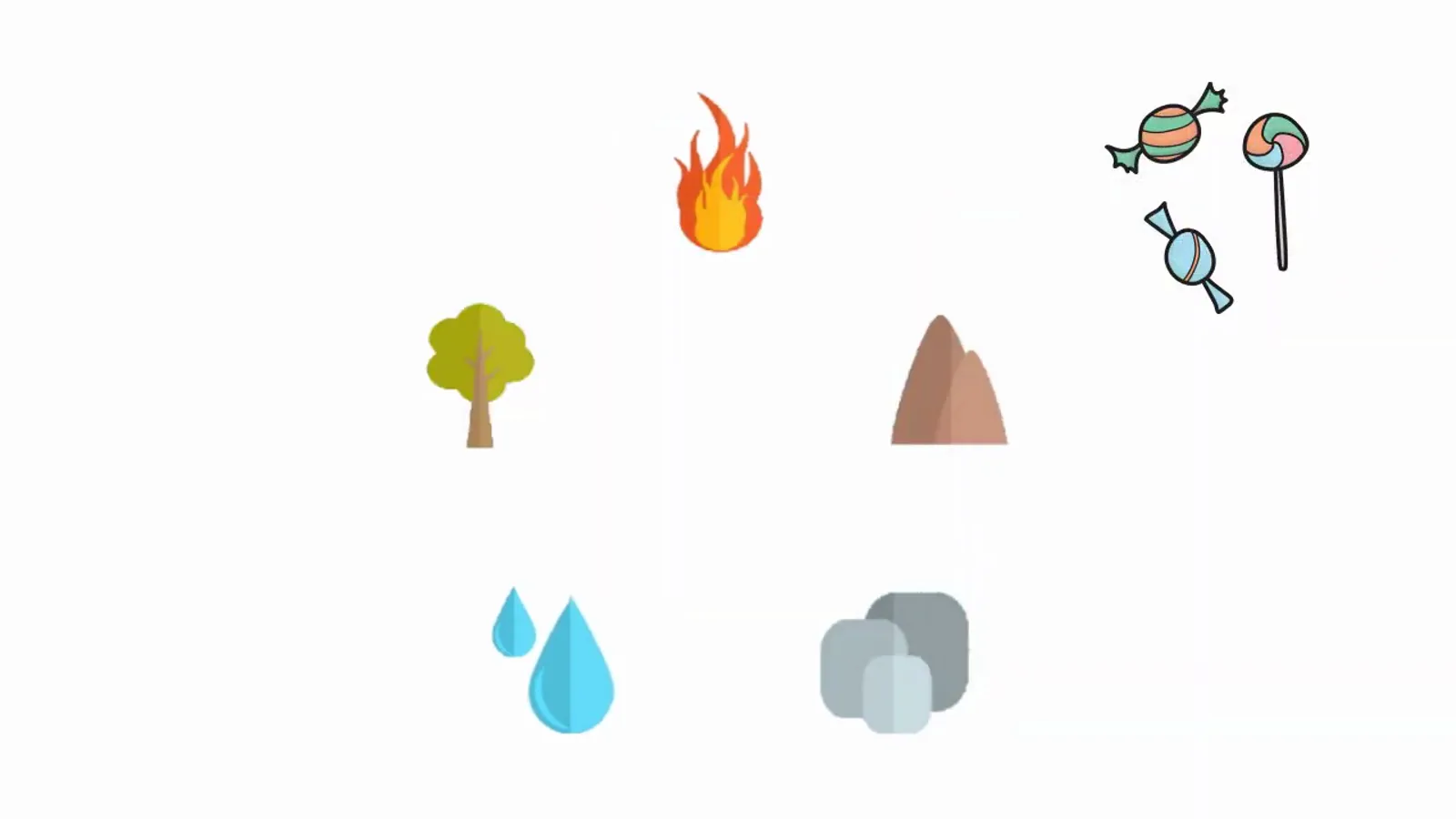
Sweets and fast food pile excess onto earth, which then insults wood.Watch at 2:34 - 11
When control breaks down completely
The red cross marks the moment the normal controlling arrow stops working: the repressed element can no longer do its job, and the cycle that should regulate everything seizes up. Just like the over-controlling sequence, the insulting sequence can happen in every element — any element can end up the bully or the victim.
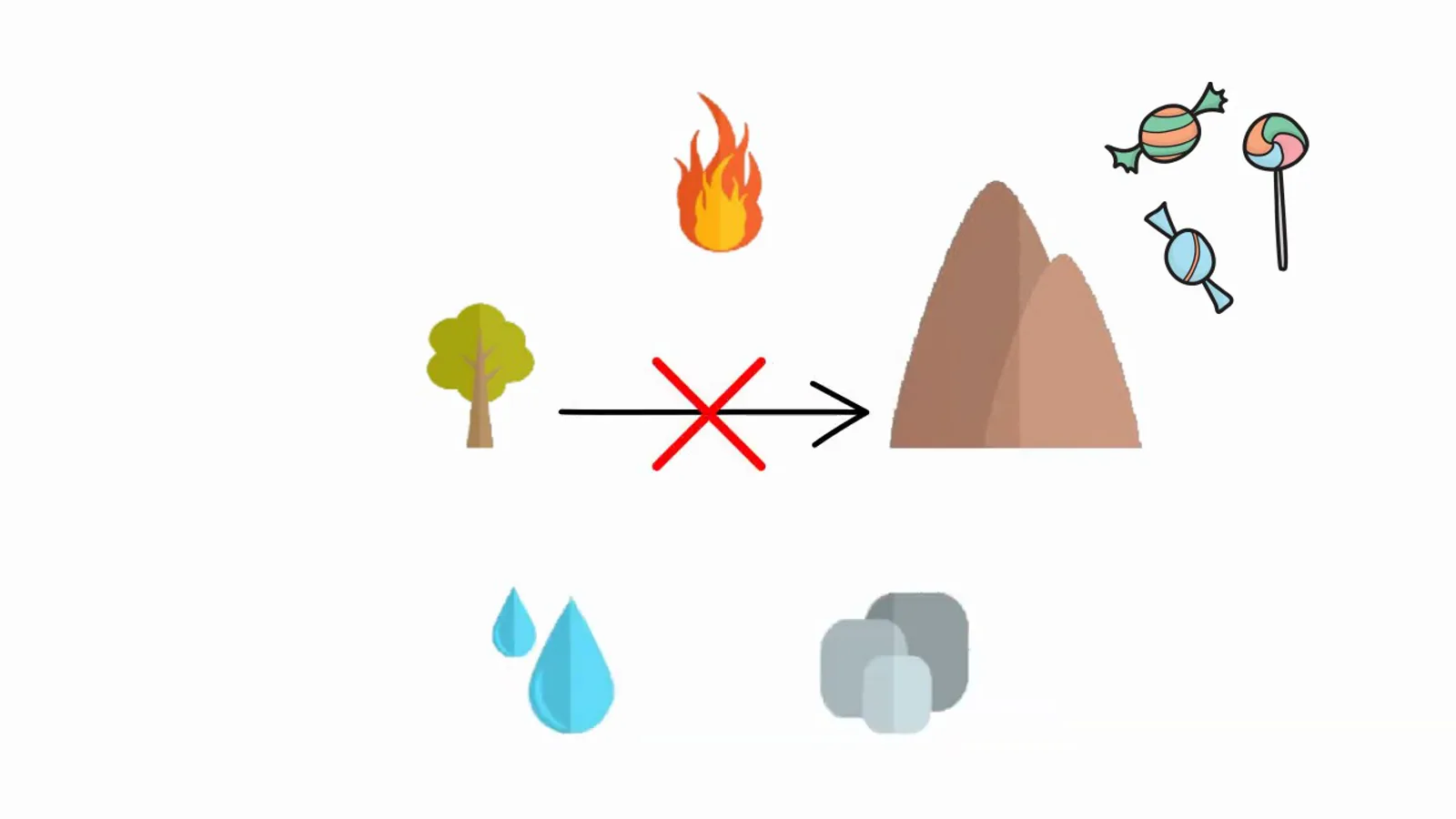
A red cross on the arrow: the controlling relationship has broken down.Watch at 2:43 - 12
Keep the scales level — balance can always be restored
The video closes on the finished board: if we live a balanced life with enough sleep, healthy food and no stress, nothing stands in the way of staying healthy and balanced. And when you do get out of balance, no worries — with the right lifestyle adjustments, every balance can be restored. The same logic is why a name's element mix matters: it should support you, not overload you.
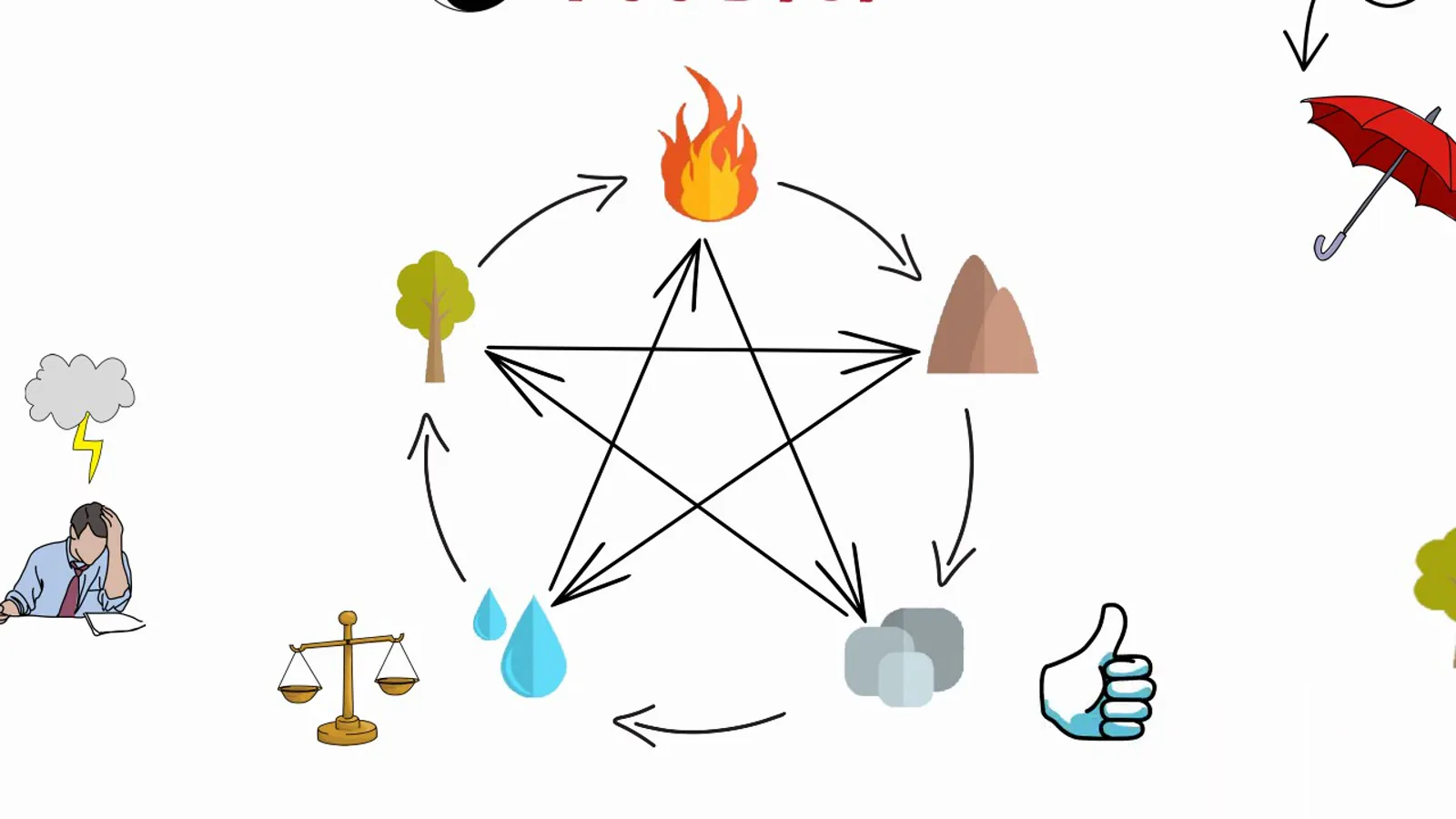
The finished board: two cycles, one balance — and a thumbs-up.Watch at 2:59
Frequently asked questions
- What does wu xing mean in English?
- Wu xing is usually translated as 'five elements', but 'five phases' is closer to the original idea. The five — wood, fire, earth, metal and water — are not kinds of matter but processes, each with its own movement, season, taste and corresponding organ and emotion.
- What is the difference between the generating and controlling cycles?
- The generating cycle links each element to the one it nourishes — wood to fire to earth to metal to water and back to wood. The controlling cycle adds checks: fire controls metal, metal generates water, and water controls fire in return. Together the two cycles keep the five elements in balance.
- What are the over-controlling and insulting sequences?
- Both describe imbalance. In the over-controlling sequence, an excess element harms the one it normally checks — long anger over-activates wood, which then represses earth and brings nausea, weak digestion and tiredness. In the insulting sequence the direction reverses: excess earth in the form of dampness, often from too much sugar and fast food, impairs wood instead.
- How do I find the five-element balance of my own name?
- Every Chinese character tends toward one of the five elements, so a name is a small wu xing system of its own. Generate a Chinese name with our five-elements name generator and look at which elements its characters carry — then use the season, organ and emotion table in this guide to read what that mix means.
Keep going
© 2026 AIChineseName.