
Pinyin Initials and Finals: How to Pronounce Any Chinese Name You Generate
Pinyin looks like English but it doesn't behave like English — the same letters hide different sounds, which is exactly why romanized Chinese names get mangled. This guide breaks the pinyin system into its two parts, initials and finals, walks through each group with charts from a beginner lesson, and shows how every Chinese character's pronunciation is just one initial plus one final plus a tone. Ten minutes from now you will be able to decode any name's pinyin on sight.
Key takeaways
- Pinyin has 26 familiar letters but different sounds — never read pinyin with English letter values.
- Every syllable splits into an initial (a consonant, 21 of them) and a final (a vowel or vowel-starting sound, 36 of them).
- y and w are only formal initials, not true consonants.
- The 36 finals come in three groups: 6 simple, 13 compound, and 16 nasal finals.
- er is a special final: it never follows an initial and its r is a curled tongue.
- One character = one syllable = initial + final + tone; some syllables, like è, have no initial at all.
The pinyin system, step by step
- 1
Pinyin splits every sound into initials and finals
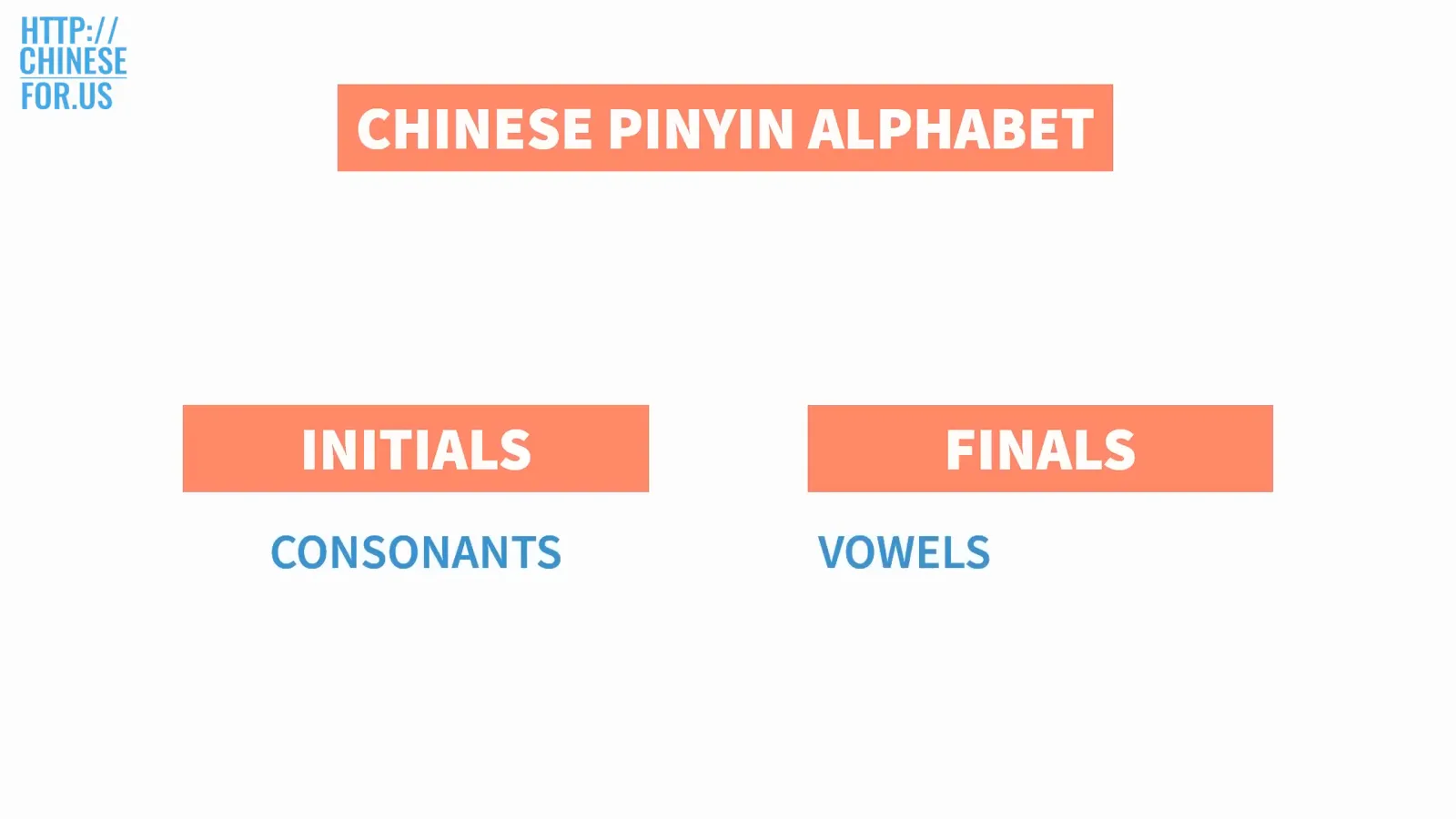
The pinyin system uses a Roman alphabet — 26 letters that look just like English. But the same letters don't always sound the same, so treat pinyin as its own code. The system has exactly two parts: initials, which are consonants, and finals, which are either vowels or sounds that begin with a vowel. Every Mandarin syllable you will ever pronounce is built from these two pieces.
Initials are consonants; finals are vowels or vowel-starting sounds.Watch at 0:25 - 2
Meet the 21 initials
There are 21 initials: b, p, m, f, d, t, n, l, g, k, h, j, q, x, zh, ch, sh, r, z, c, and s. Several look identical to English consonants but behave differently — q is a sharp ch sound, x is a soft sh, c is a ts. When you see a name romanized as Qin or Xiao, the letter is telling you a Mandarin sound, not an English one.
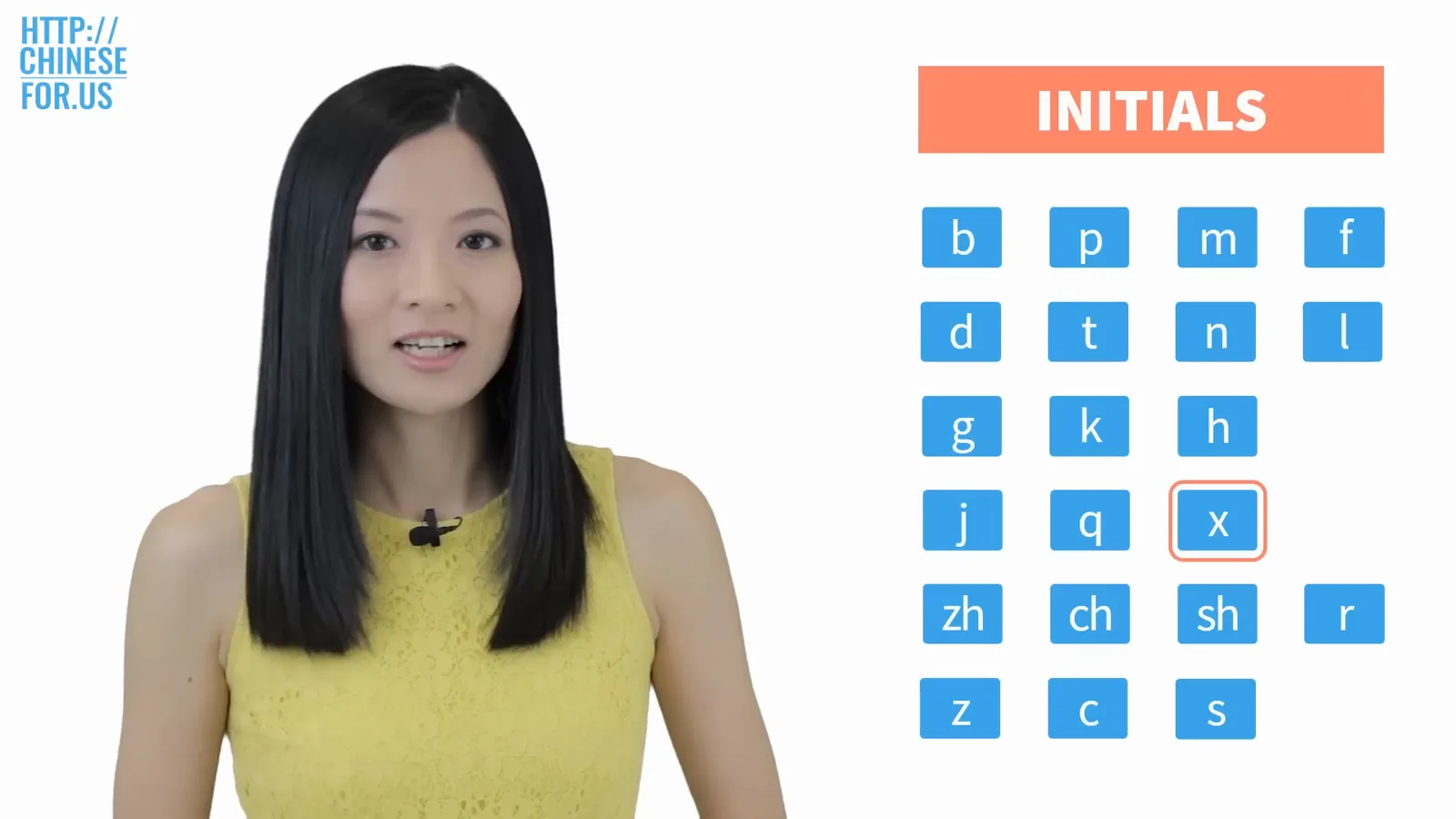
The 21 initials — read them as Mandarin sounds, not English letters.Watch at 0:55 - 3
y and w are not real initials
Alongside the 21, you will see y and w doing consonant work in syllables like Yan or Wang. The lesson calls them formal initials: they are not true consonants but spellings that appear when a syllable would otherwise begin with a vowel. Knowing this explains why some names start with y or w while their chart sound starts with i or u.
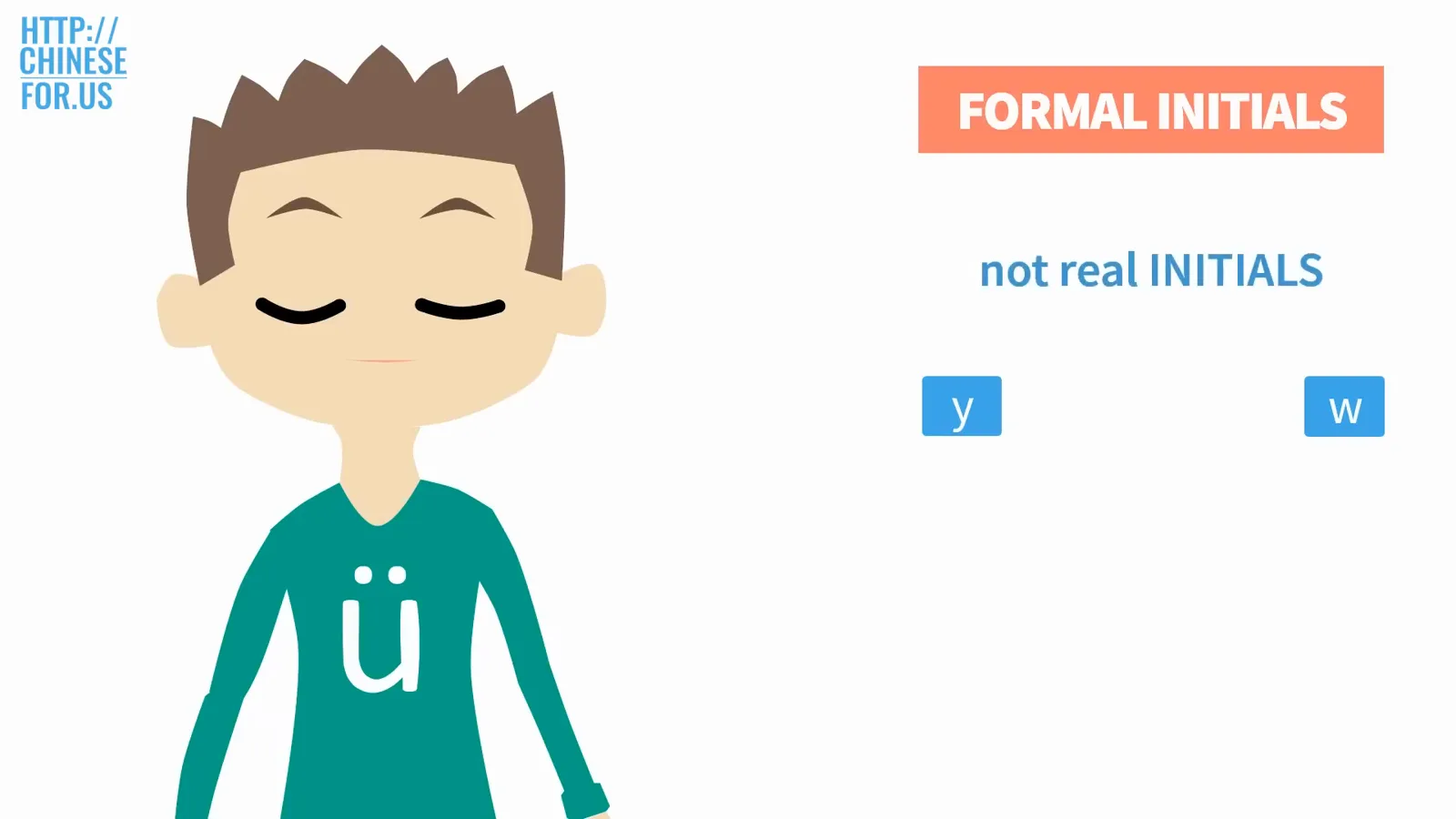
y and w are formal initials — spellings, not true consonants.Watch at 1:10 - 4
The 6 simple finals are single vowels
There are 36 finals, and the first group is the simplest: a, o, e, i, u, and ü — each one a single basic vowel. These are the purest sounds in Mandarin and the backbone of every longer final. Note that ü, the umlaut vowel that English doesn't have, is what makes the ü in names like Lü sound tight and fronted.
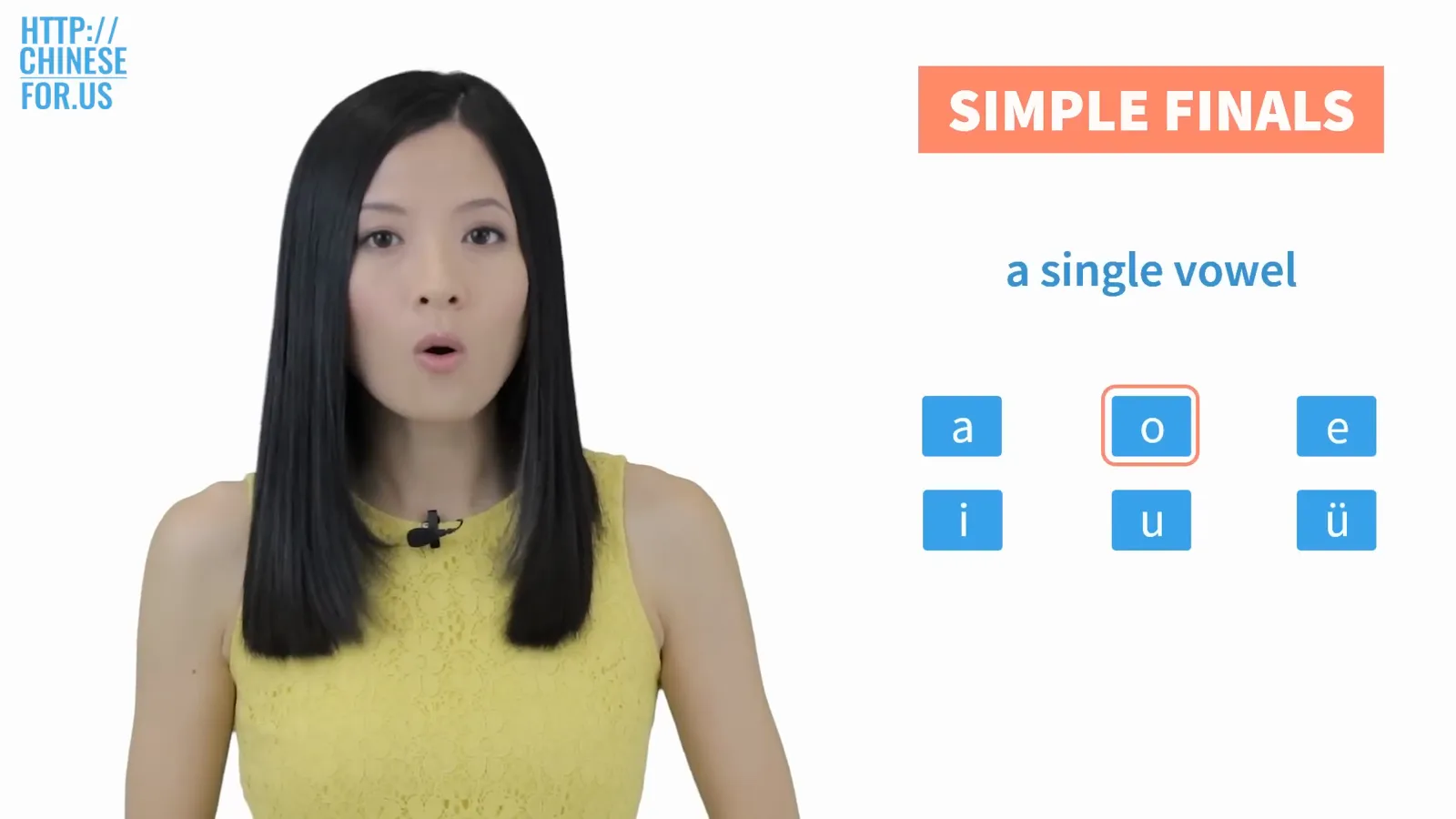
Six simple finals — a, o, e, i, u, and the umlaut vowel ü.Watch at 1:35 - 5
The 13 compound finals chain two or three vowels
Compound finals are composed of more than one vowel: ai, ei, ao, ou, ia, ie, ua, uo, üe, iao, iou, uai, and uei. Two of them get spelling shortcuts — iou is written iu and uei is written ui, which is why the name Liu has three vowel sounds packed into three letters. Glide smoothly through the vowels instead of stacking separate syllables.
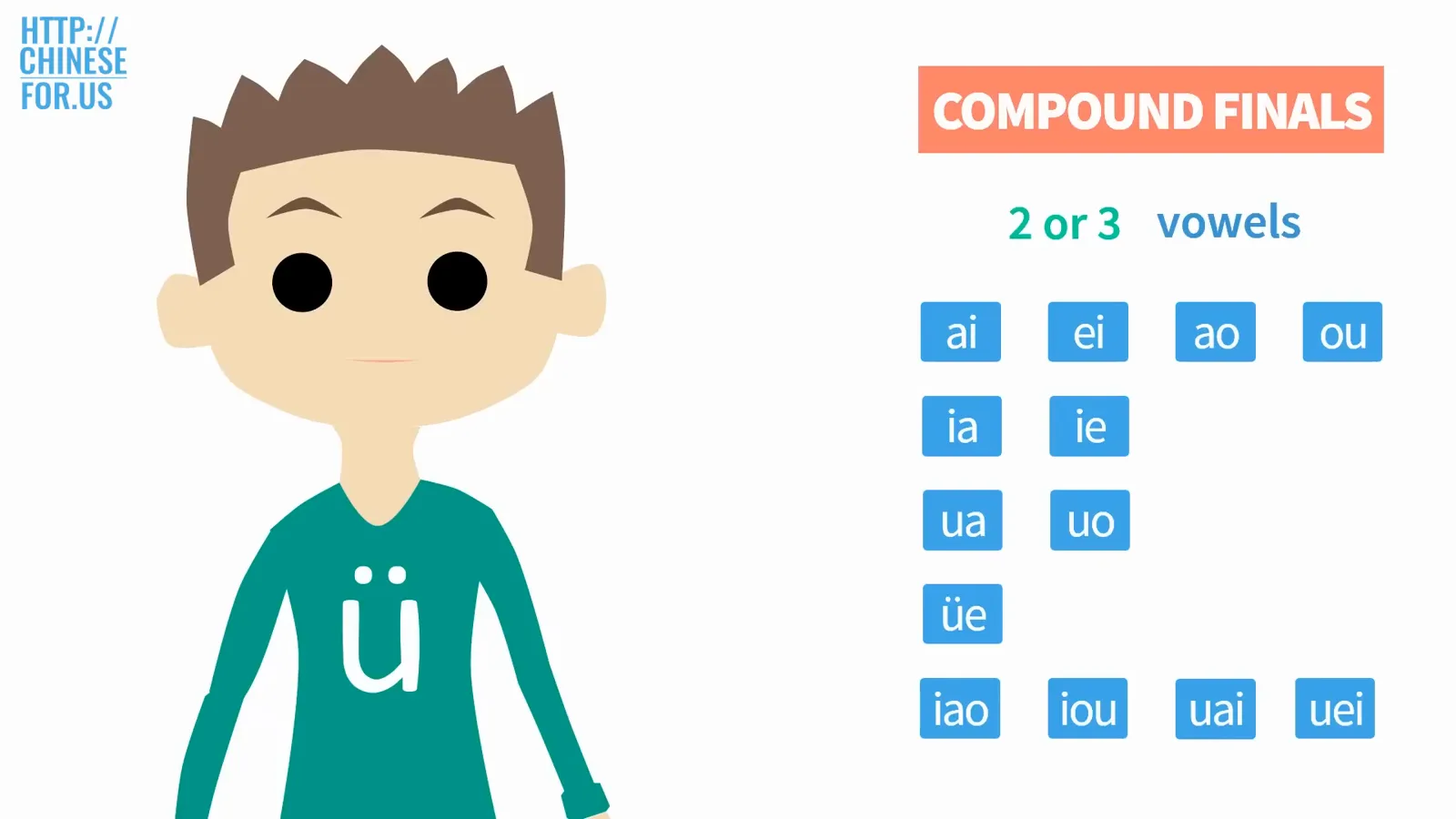
The 13 compound finals — chains of two or three vowels.Watch at 1:53 - 6
The 16 nasal finals end in n or ng
The last group starts with a vowel and ends with a nasal consonant: an, en, in, ün, ian, üan, uan, un, ang, eng, ong, ing, iang, iong, uang, and ueng. The difference between an -n ending and an -ng ending is exactly what separates names like An and Ang, or Lin and Ling — worth training your ear on early.
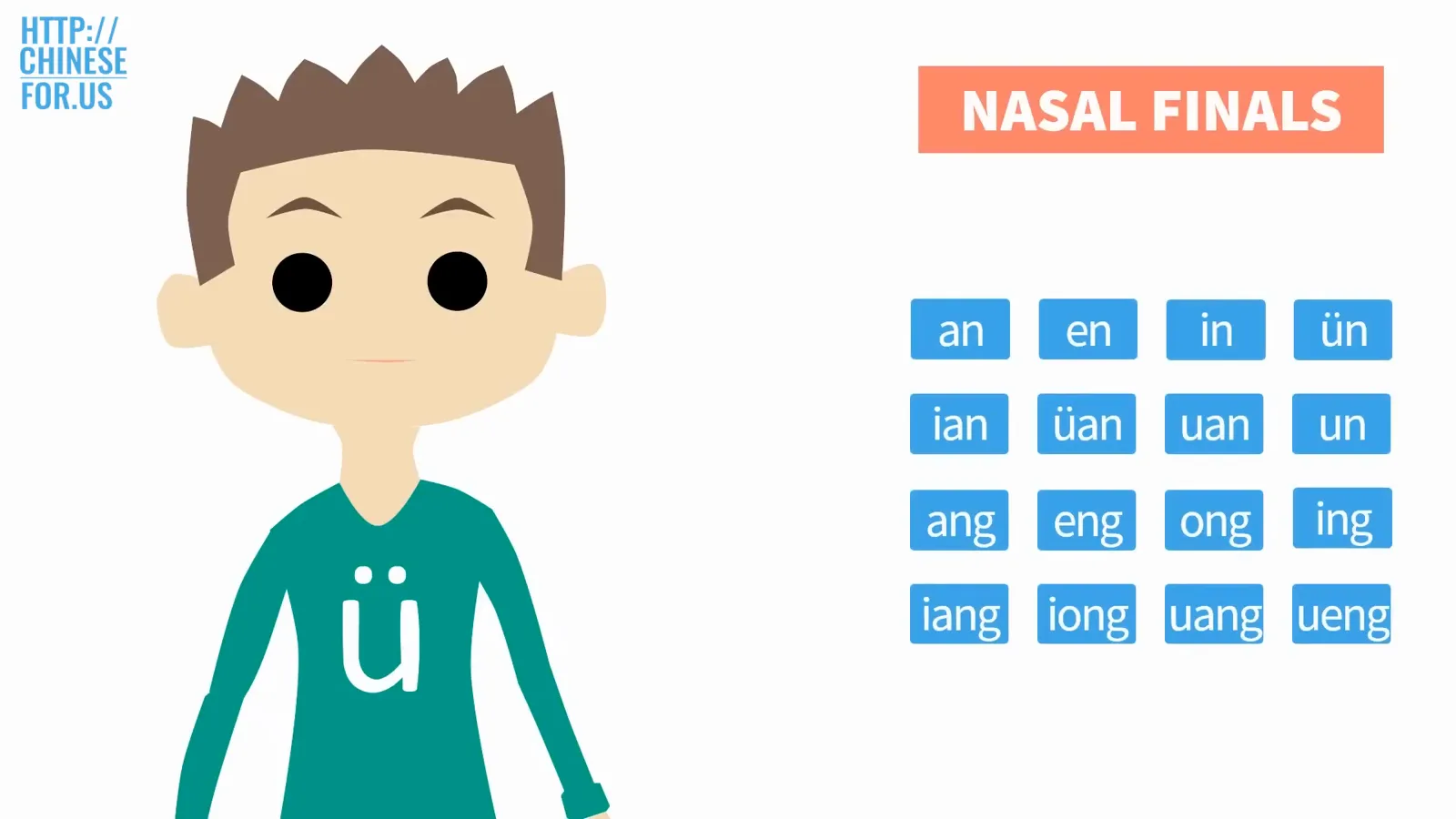
The 16 nasal finals end in n or ng.Watch at 2:28 - 7
er, the final that stands alone
One final breaks all the rules: er. It can never follow an initial — it is always a syllable by itself — and its r doesn't work like an English r at all; it signals a quick curling of the tongue. You hear it in Beijing-flavored words like ér, and knowing it exists explains sounds in names that otherwise look unpronounceable.
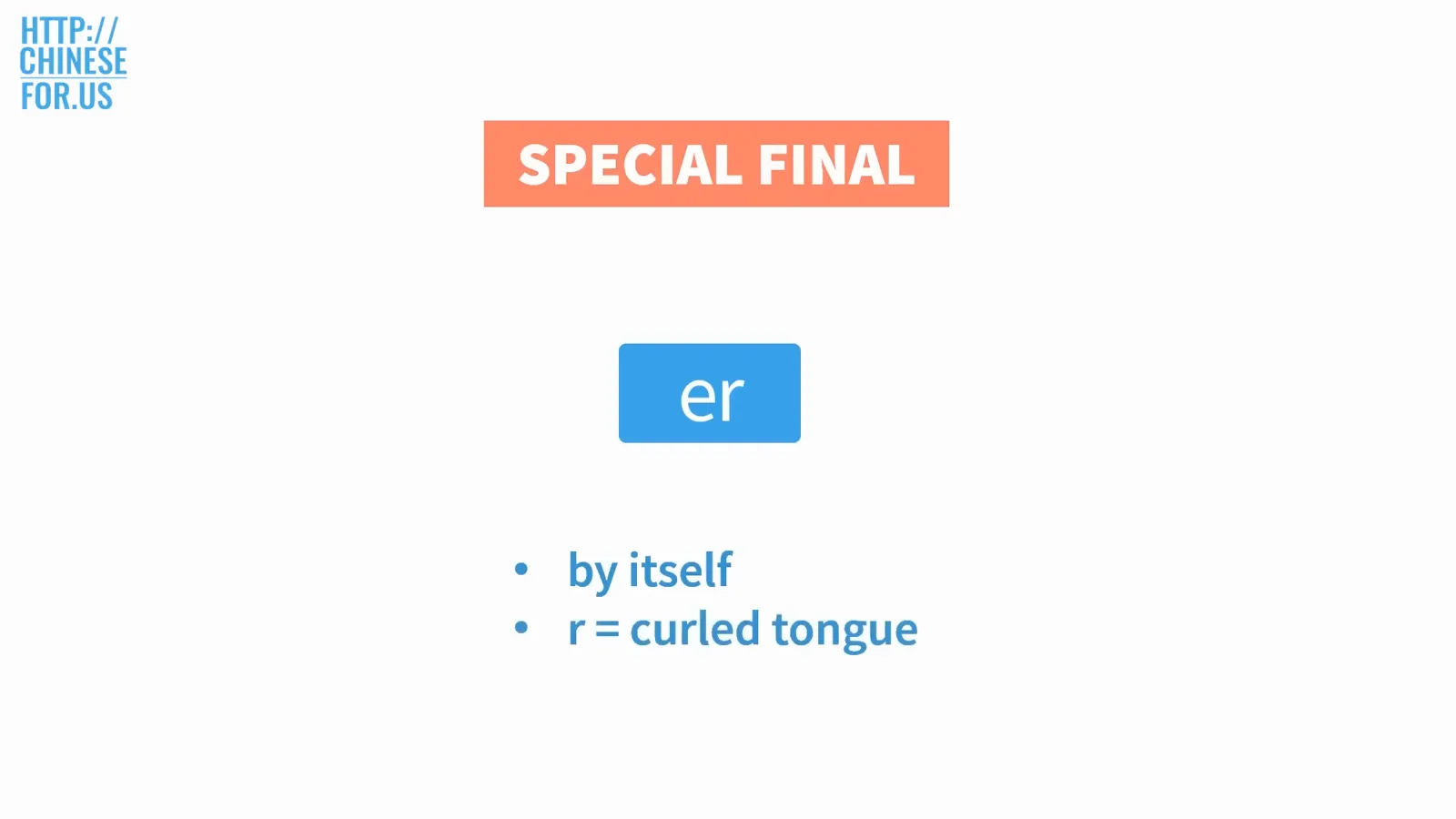
er never follows an initial — the r marks a curled tongue.Watch at 3:25 - 8
One character, one syllable, three parts
Chinese is built from characters, and in speech one character is generally one pinyin syllable. Each syllable usually has three parts: an initial, a final, and a tone. Read any name's pinyin by splitting it this way — the consonant up front, the vowel sound behind it, and the tone number telling you the pitch — and pronunciation stops being guesswork.
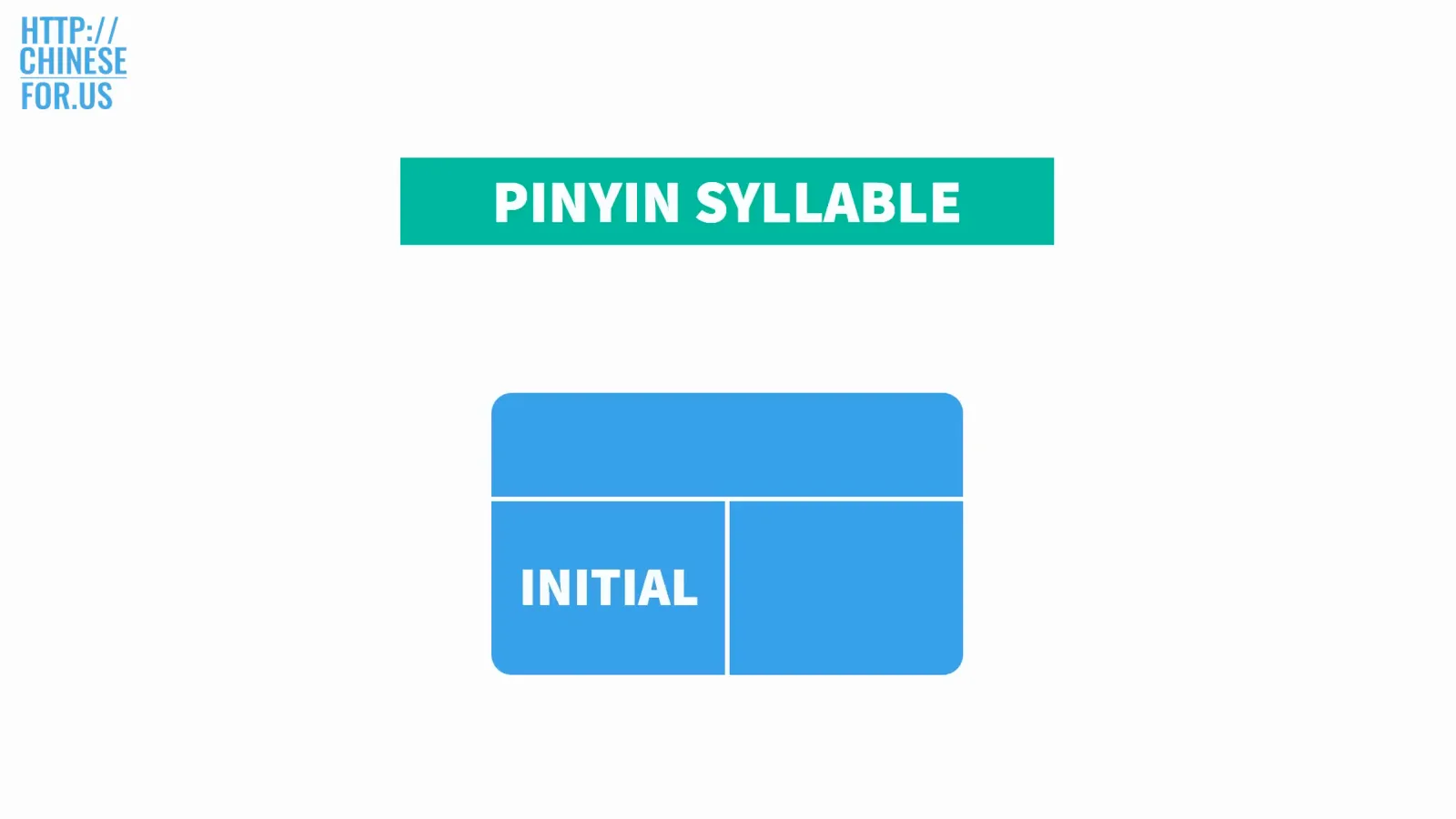
A pinyin syllable = initial + final + tone.Watch at 3:50 - 9
Some syllables have no initial at all
Not every syllable carries a consonant. Zero-initial syllables consist of only a final and a tone — è (hungry) is just the vowel with a falling tone. In names, these show up as standalone vowels, and combined with the formal initials y and w they cover every vowel-starting name sound.
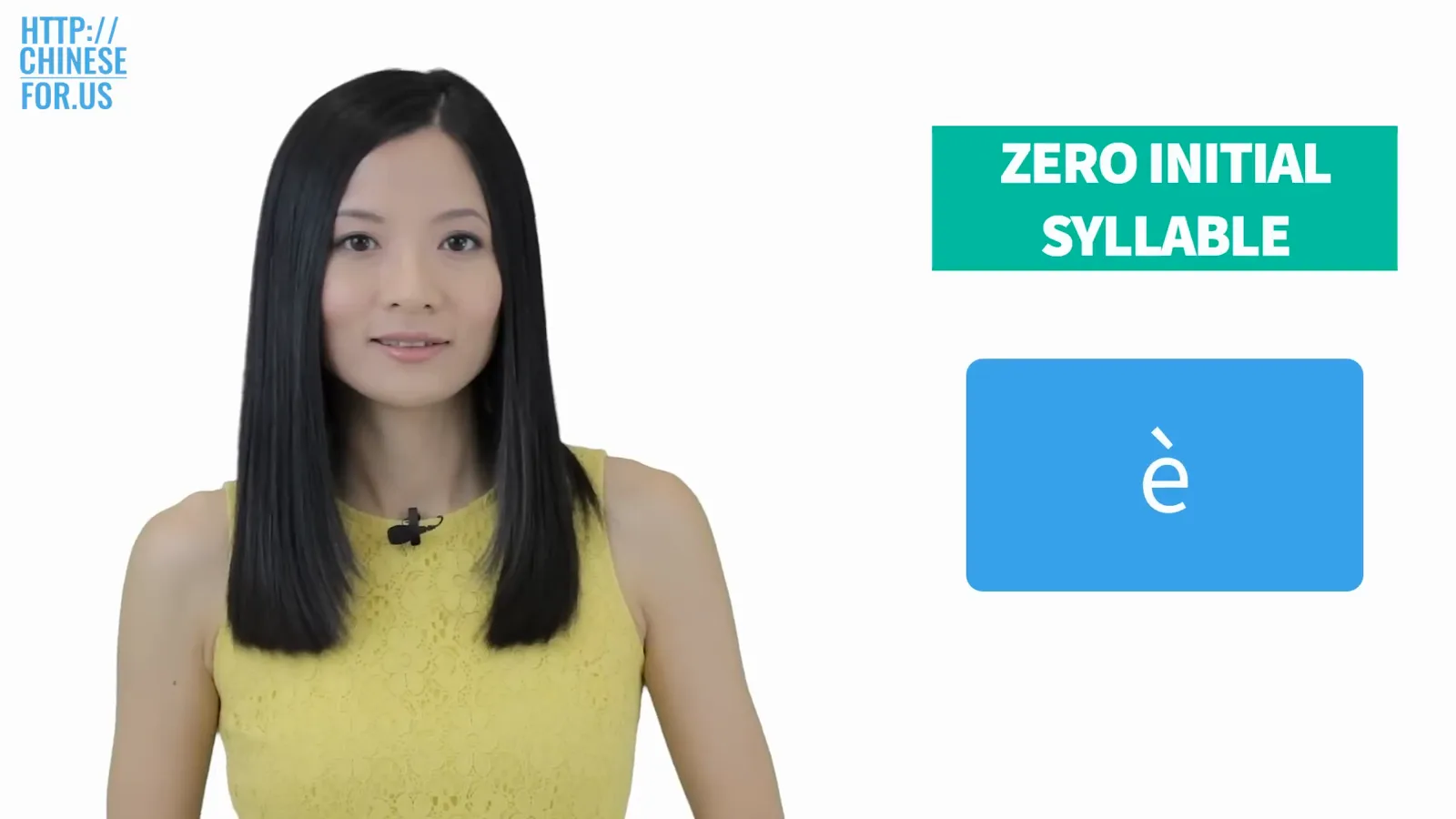
è has only a final and a tone — no initial consonant.Watch at 4:38 - 10
Why pinyin matters for your name
Pinyin is a transcription tool, not the language itself — publications print characters, not pinyin. But for learners it does three jobs: it helps you remember how each character sounds, it lets you write a name you can say but can't yet draw, and it's how you type characters on a phone or laptop. Generate your name, read its pinyin initials and finals aloud, and the characters stop being pictures.
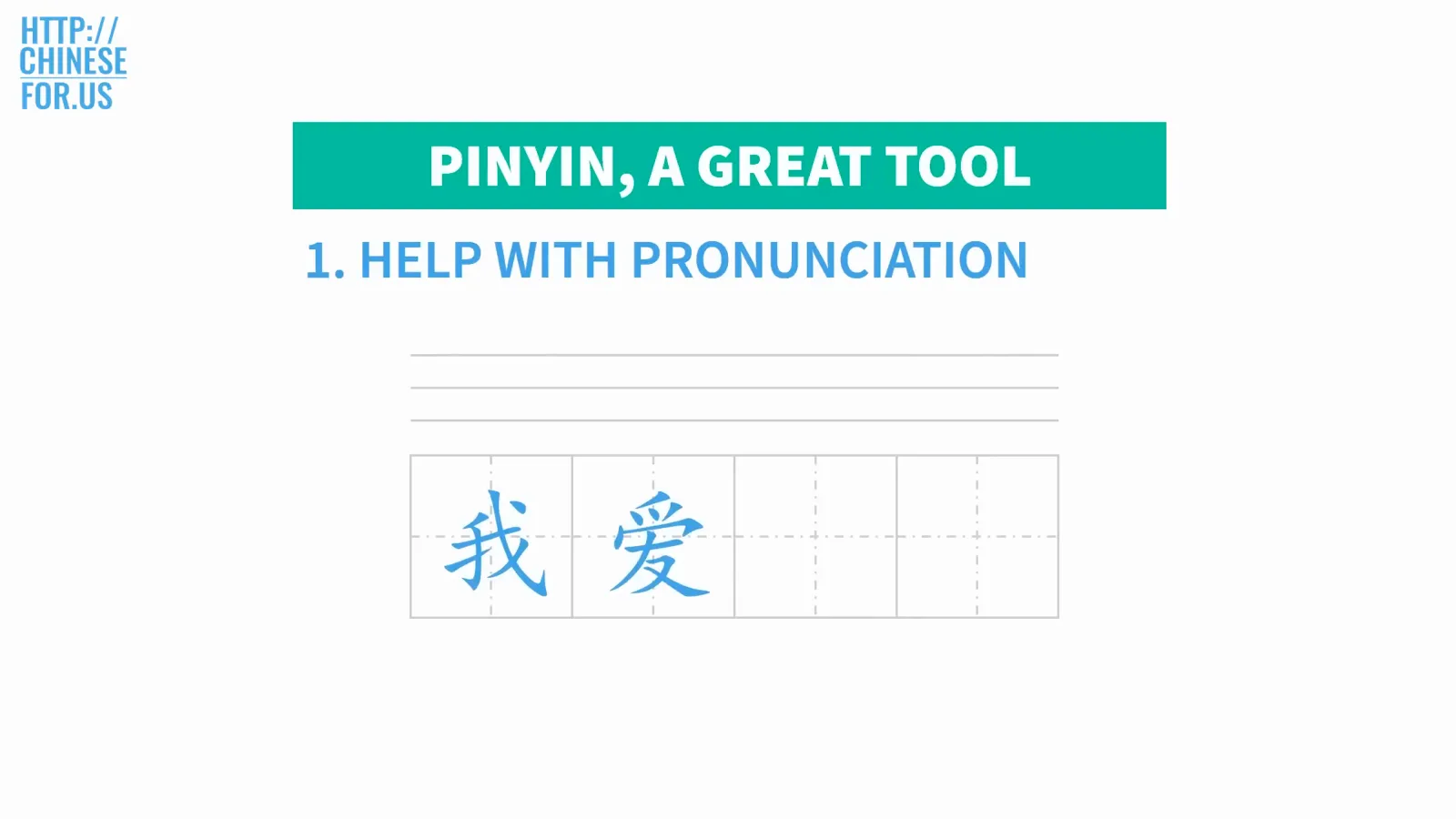
Pinyin records the sound of 我爱中文 — I love Chinese — character by character.Watch at 4:48
Frequently asked questions
- What is the difference between an initial and a final in pinyin?
- The initial is the consonant that starts a syllable — Mandarin has 21, from b and p through zh, ch, sh, r, z, c, s. The final is everything after it: a vowel or a vowel-plus-nasal sound, 36 in total. A syllable like Xi is initial x + final i; a syllable like Wang is initial w + final ang.
- Why do pinyin letters sound different from English?
- Pinyin borrowed the Roman alphabet but assigned letters by Mandarin sound value. So c is a ts sound, q a sharp ch, x a soft sh, and zh a retroflex j-like sound. Reading a name like Zhang with English values is the number one reason names get mispronounced.
- How many sounds do I need to pronounce any Chinese name?
- Just the inventory in this lesson: 21 initials plus 36 finals, combined one-to-one and topped with one of four tones. That finite set covers every syllable in every Mandarin name — no character requires a sound outside this system.
- How does this relate to the four tones?
- Initials and finals build the syllable's shape; the tone gives it its melody. A name syllable needs both — the right initial and final make it recognizable, the right tone makes it sound native. Our four tones guide covers the pitch contours in detail once you're comfortable with the letter sounds.
Keep going
© 2026 AIChineseName.